I'm an avid book reader and reviewer located in San Antonio, Texas. These videos are meant to help potential readers of these books to decide whether they might find them interesting or worth their time. I welcome all questions, comments and concerns regarding the content herein.
[The above is mostly a
reading of the text below, with an occasional aside thrown in for good measure,
as they strike me as relevant. I welcome
questions, comments, or concerns about the material contained in this video.]
Zygmunt Bauman is a Polish-born sociologist in the Marxist tradition mostly known for his thoroughgoing critiques of consumerism, modernity, and cultural memory (especially the Holocaust). His “liquid” books, including “Liquid Modernity” (2000), “Liquid Love: On the Frailty of Human Bonds” (2003), “Liquid Life” (2005), “Liquid Fear” (2006), and the book presently considered, “Liquid Times: Living in an Age of Uncertainty” (2006), for the most part seem to be shorter books whose aim is to adumbrate the arguments Bauman has made over the course of his career.
The focus of “Liquid Times” is a meta-critique of globalization and all of the problems it presents, from rootlessness to the ubiquity of the security sate, with Bauman’s central thesis being that the consequences of globalization have seriously hindered attempts at international justice. The goal of globalization - to eradicate any trade barriers and therefore create “markets without frontiers” - results in the transition from a world where people are subject to the laws and protections of their home countries to one in which radical fear and lack of security are reified and the “fading of human bonds and the wilting of solidarity” reigns. This lack of security results in fear and a perceived lack of control, which in turn perpetuates and shores up the conspicuous shift toward national security that we have experienced in advanced liberal democracies. And so the pernicious cycle goes. In his comparison of cities, the globally located ones (that are able to participate in the fully integrated sphere of globalization) and locally located cities ones (those that aren’t), Bauman says that the job of the city has changed from protecting its inhabitants from outsiders to housing ghettoized populations of peripatetic transnationals and strangers, the “dumping ground for globally conceived and gestated problems.”
Our new liquid times have also brought about an unprecedented number of refugees, both political and economic. Wars, which Bauman thinks are essentially local attempts to solve global problems, become intractable. The result is an “excess of humanity” – humanity as waste product – completely and utterly divested of property, personal identity, or even a state that will recognize their existence.
Bauman suggests that democracy has ironically become an elitist affair, where the rich protect their interests and the poor continue to suffer from a lack of social safety nets and supportive governmental networks. He is also not terribly optimistic about the chances of gaining a pre-globalized utopia, a word which Thomas More first darkly noted could mean, homophonically, either “paradise” or “nowhere.” While it is still a paradise for some, our world has become too liquid to be anything but the latter for most of us. In the end, Bauman offers in every analysis of globalization the ultimate paradox of modernity: a permanent life shot through with impermanency.
As I pointed out before, at least according to the back of the book, Bauman has taken the time to further detail his analyses in other books. However, from what I read here, I am not sure how many of his arguments are original. Books on globalization with themes of alienation and disenfranchisement are not unpopular in the field of sociology. However, Bauman’s wry wit definitely has me interested in reading more of his work, which I plan on reviewing in the future.
[The above video is mostly a
reading of the text below, with an occasional aside thrown in for good measure
as they strike me as relevant. I welcome
questions, comments, or concerns about the material contained in this video.]
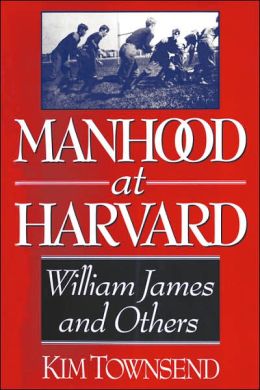
This is a really beautiful extended essay on a variety of interdisciplinary themes, from sociology to culture to philosophy to college life at Harvard at the end of the nineteenth century. Townsend, one of whose academic interests on his Amherst page is listed as “American Literature and Culture, 1865-1925,” earned his Ph.D. at Harvard and it’s obvious that the culture both grew on him and continues to fascinate him.
As the title divulges, this is a book largely concerned very much with what could be called the “cult of manhood” at Harvard between approximately 1865 and 1905, focusing heavily on both the colleagues and students of American philosopher and pragmatist William James. Because of the time period covered, Townsend’s interest is almost exactly coeval with the leadership of Charles William Eliot, Harvard’s longest serving president, from 1869 to 1909. James, Eliot, and Lowell (the President who directly followed Eliot) all believed that Harvard was a kind of intellectual confraternity. This language, both inside and outside the institution of higher education, sounds old-fashioned, and it is. We never hear people speak this way anymore. Depending on who was speaking, there were various amounts of misogyny, imperialism, and racism behind these declarations, with William James being perhaps one of the more liberal and humanistic, and the big, bold blustering of Teddy Roosevelt (class of 1880) holding up the other side of the spectrum.
However, the narrow topic of “manliness at Harvard” is not sustained for the entire book. Townsend is interested in James’ early life, especially the time he spent in his late twenties suffering from what was then identified as “neurasthenia” - what we might today call bipolar disorder or possibly depression. There are judicious interludes describing James’ pragmatism, which I’ve always found a peculiar flurry of Emersonianism and Stoicism. James’ writing has always struck me as having so much that is American in it. Its ability to temporize, its relentless sympathy with religiosity, to create itself anew – these were always attractive qualities. However, I was always put off by its explicit disinterest in metaphysics or ethics, even if I might invariably disagree with its conclusions. Whatever my personal opinions of James’ thought, Townsend has an infectious passion for James the man and James the teacher, as well as Alice (his sister) and Henry Sr. (his father).
Townsend also covers several elements of ordinary college life, especially the sea change in opinion that was occurring in sports. Before the 1860’s, sports were an afterthought at Harvard, a distraction from the scholarly pursuit of Latin, Greek, and Dante. After the Civil War, a decidedly pro-sports faction arose; some were moderate in their advocacy, thinking that a healthy body was just as important as a healthy mind, while others (especially Roosevelt) couldn’t possibly conceive of becoming a man without rowing crew or being on a football team. President Eliot bemoaned the rise of sports, seeing it as an unnecessary incursion into collegiate culture, but suffered it silently for the most part. Townsend also details how Eliot, the great reformer that he was, regretted the rise of specialization and professionalism associated with college education, holding the older, humanist position that it was the duty of every person (that was, for a long time, every man) to better himself through the pursuit of learning, not just of those who wants to crudely utilize their education for monetary gain.
While the central figures are undeniably Eliot and James, the peripheral ones abound: George Santayana, Henry Adams, Nathaniel Shaler, Gertrude Stein (whose passion and interest in James was undying), Teddy Roosevelt, and W. E. B. Du Bois. Even though these people were all at the elite educational institution that Harvard became during the last third of the nineteenth century, it’s still wonderful to think that so many great minds mixed there not so long ago, and the book provides generous excerpts from their letters. Above all, Townsend provides a portrait or a specific time and culture in American history which is truly past. So much of it strikes us modern readers as crude and full of machismo, and we must not make the crucial mistake of being too quick to pass judgment. There is also a lot that inspires and emboldens the imagination here: it would be easy to idealize and romanticize the time and place, even for its many obvious flaws. This is a careful balance of biographical information, intellectual history, and college life which deserves to be taken seriously by anyone compelled by these subjects.
Special thanks to my Goodreads friend Lauren who kindly sent me this book (as she generously has so many others).
[The above video is mostly a reading of the
text below, with an occasional aside thrown in for good measure as they strike
me as relevant. I welcome questions,
comments, or concerns about the material contained in this video.]
In this book, Moore’s stated purpose is to delineate some historical connections between ideas of moral purity and persecution or ostracization. After a few moments of reflection, however, it strikes me as difficult to think of many instances in which persecution that didn’t have their roots in some notion of purity, moral or otherwise. It especially won’t come as a surprise to anyone familiar with the wide swath of anthropological literature on the subject, like Mary Douglas’ “Purity and Danger.” I thought this book might have something new or interesting to say about it, but I was wrong.
This book has at least two problems that should be considered egregious shortcomings in a book of such sweeping history. Firstly, the paucity of examples from which he chooses to draw is problematic. He considers only, in chronological order: the literature of the Old Testament, the religion wars of sixteenth-century France, the French Revolution, and “Asiatic civilizations.” Secondly, one walks away from the book with the idea that the topologies of persecution – how they shame, in what circumstances they occur, their sociological functions, et cetera – are never explored. There is nothing for the almost two millennia between the Old Testament and the France of the 1500s. And then there’s the fact that “Asiatic civilizations” is so anachronistic as to be risible. But then again, so is the picture in the back of the book, showing him with a gigantic corncob pipe hanging out of his mouth.
The thesis of the book is that, in the first three historical instances, persecution and concepts of moral purity were closely tied together, while in “Asiatic civilizations” (he considers Confucian and Buddhist religious thought here mostly), the connection is much more tenuous, and perhaps even nonexistent. We are simply told, in instance after instance, that people were persecuted or driven out of different movements or societies (the radicals in the Revolution, Jewish society of the Old Testament, et cetera) because they broke some sort of ethical-moral stricture. This almost reduces the entire book to a set of linear, historical treatments whereas I thought that it would bring in something more integrative and interdisciplinary.
[The
above video is mostly a reading of the text below, with an occasional aside
thrown in for good measure as they strike me as relevant. I
welcome questions, comments, or concerns about the material contained in this
video.]
This book is an extension of Peter Berger and Thomas Luckmann’s earlier book, “The Social Construction of Reality: A Treatise in the Sociology of Knowledge” written in 1966, in which the authors begin with basic sociological assumptions about mental representations and how human beings come to know the world and form impressions of it. “The Sacred Canopy,” while heavily informed by the ideas in “The Social Construction of Reality,” was written only by Berger himself. The book is a thoroughly Marxist critique of religion with a dash of Freud thrown in for good measure.
The Marxism comes from Berger’s understanding of human consciousness. He emphasizes the dialectical nature of individual man and his relationship to culture and society. According to him, we can only “world-build” (or “cosmize,” to use his argot) through a process of constant internalization and externalization of distinct mental representations. Berger defines religion as a sacred form of world-building, an “audacious attempt to conceive of the entire universe as humanly significant” (p. 28). (Forget temporarily, as I had to, that to call religion a “sacred” form of world-building seems to very much beg the question.) He argues religion to be the oldest, most powerful legitimizing order which plays a central role in construing order and rationality in our lives, and therefore in maintaining reality because they are the only things that can provide sacred legitimation for this socially constructed reality. Thus religion makes permanent the temporary, transcendentalizes the immanent, sacralizes the profane, and ensures a nomological (that is, rational and law-based) rather than chaotic reality.
Evil, death, injustice, and suffering can threaten the nomological world that is shored up by religious legitimation. However, theodicies minimize the threat to “nomos” by bestowing meaning on these things and by making them understandable in a larger epistemological scheme. Berger claims that religion is ultimately alienating, as it enforces the idea that the socially constructed world is not a human product, but rather a permanent product of divine construction; religion is, in other words, a source of false consciousness that perpetuates the idea that human beings had nothing to do with creating their social world. He also claims that the world is gradually becoming more secular.
For exactly these reasons, secularization is paradoxically both de-alienating, while at the same time anomic and ridden with existential anxiety precisely because religion, according to Berger, has lost its legitimacy, having slowly been replaced in the industrial world with a materialistic-positivistic model for knowledge. In short, secularization allows people to realize that the world is their own, not that of a distant, supernatural God, and that our disconnection from this leaves us hanging, alone, in a world devoid of any meaning or order.
Berger claims to break down the book into two parts, the first being the theoretical portion and the second providing the concrete, historical, empirical facts that support the theory. However, I found almost no substantive distinction in the level of theory used in the two parts. Both are highly theoretical and abstract, which is not to say that the text is difficult if afforded a careful reading. But the entire book is maintained on such a level of abstraction that it would be difficult to take any “applied” ideas away from it. This might have something to do with the fact that Berger recanted the central thesis of “The Sacred Canopy” about twenty years ago in the face of evidence that directly suggested that the boundaries of secularization and modernization were not necessarily coterminal.
Also, for being published less than fifty years ago, the ideas here seem much, much older. Connecting the ideas of secularization, alienation, and social anomy – which seem to me to the fundamental concept here – go back to the nineteenth century, and Berger doesn’t seem to work in any new ideas. This book is interesting for its historical value and arguments (it is still seen on sociology reading lists nearly everywhere), but it doesn’t bring much “value added” to the contemporary sociology of knowledge or religion.
[The
above video is mostly a reading of the text below, with an occasional aside
thrown in for good measure as they strike me as relevant. I
welcome questions, comments, or concerns about the material contained in this
video.]
Ernest Gellner (1925-1995) was a French-born Czech-Englishman whose interests are as varied as his string of ethnonyms would suggest. In addition to holding well-known chairs in sociology, anthropology, and philosophy, he was also interested in the methodological foundations of science, the political culture of Islamic societies, and dismantling what he considered to be three of the biggest con-games that have taken in intellectuals of the twentieth century: postmodernism, Freudianism, and Marxism. Perhaps his best-known book is “Plough, Sword, and Book.”
This is an imprint from the University of Wales called “Political Philosophy Now,” and aims to summarize Gellner’s oeuvre. Lessnoff does a competent job at this, even if his approach isn’t nearly as witty and sharp as Gellner’s notoriously was. His delivery is flat and academic, but he’s clearly very familiar with Gellner’s work, and especially the conversations in which Gellner was intellectually engaged. Since I haven’t read any of Gellner’s original work, I can only assume that his interpretation of Gellner is accurate. He’s certainly not an apologist for Gellner, and openly criticizes him when he feels it is necessary.
I won’t discuss all of the topics here, but I thought that some of Gellner’s work deserved particular attention. The best part of the book is the last chapter of the book called “Relativism and Cognitive Ethics.” Cognitive ethics is, as I understand it, essentially Gellner’s way of defining intellectual honesty, and is loosely synonymous with the scientific standards of testability and falsifiability in the Popperian sense. He accuses Freudians and Marxists of lacking this cognitive ethic, because imbedded in these systems are ways of deflecting all criticisms. If you’re not a Freudian, you’re simply in a state of false consciousness (note the similarity to Marxist rhetoric); you’re in denial of Freud’s truth. If you deny Marxism, you’re a useful idiot for the bourgeoisie, blind to the alienating effects of capitalism. Basically, all these systems (he goes on to critique postmodernism along the same lines), have internally coopted all criticisms, and therefore completely protects itself from attack. They’re unfalsifiable, and therefore necessarily unscientific – which is a problem when many of their practitioners wear the cloak of scientific respectability.
There are also chapters on nationalism, Gellner’s theory of history (as presented in “Plough, Sword, and Book”), politics in modern society, and a blistering attack on the linguistic philosophy popular at Oxford during the middle of the century, especially that of Wittgenstein (found in “Words and Things”). The only chapter that I didn’t find convincing was the one on Islamic society in which he states, quite oddly, that theocracies are particularly adept at conforming to modernist ideals and suggests a distinction between high and low Islam. This was counterintuitive at best.
Lessnoff’s book is a great survey of Gellner’s life’s work. I would certainly suggest this for anyone in reading one of Gellner’s books, which many of which seem difficult but very rewarding.
[The
above video is mostly a reading of the text below, with an occasional aside
thrown in for good measure as they strike me as relevant. I
welcome questions, comments, or concerns about the material contained in this
video.]
Civilizations, even the most advanced among them, are invariably strewn with mythologies, folklore, and recherche taboo. While the contemporary United States would itself provide enough material for a multi-volume study of this kind, Marvin Harris focuses mostly on pre-scientific and pre-literate peoples to answer questions like: Why do Hindus not eat cows, while Jews avoid pork instead? How do you explain the concept of the Messiah? Why was the belief in witches in medieval Europe so prevalent, and why were people so afraid of them? These bald facts have received many anthropological and sociological explanations in the past, including the one that suggests that they are simply irreducible and, therefore, unable to be analyzed. But Harris, a Marxist by conviction, necessarily must see a materialistic explanation. He looks for answers to these questions in the everyday lives and concerns of the people that entertain these beliefs. Because of this, his answers, in most instances, seem to have some bit more explanatory force than those that have preceded him.
According to Harris, the reason why we see Hindu “cow love” (his words, not mine) as odd is because we live in a very fundamentally different position with respect to cows in our day-to-day postindustrial lives. No matter the exigencies or problems in the lives of the market or our family, we can always go to the grocery story and purchase milk, butter, and meat all from a cow. However, Hindus (and he is mostly talking about Indian Hindus here) have acquired the need for an adaptive resilience in its agricultural order that we have long since shed our need for. Hundreds of millions of Indian peasants who have only one cow know that animal as the only source of milk to make it through a dry season. And if they are lucky enough to make it, it is the only thing that can pull a plow once it is time to plant or harvest crops. In short, because of the way their economy is localized around the family unit instead of our food-industrial complex, they place a different value on the cow.
Another topic Harris considers is the first-century Palestinian Judaism with its concomitant messianism. The history of this period, mainly through Josephus’ two reliable books “Jewish Antiquities” and “Bellum Judaicum,” informs us that Jesus was not unique in having the mantle of the Messiah. Between 40 B. C. and 73 A. D., Harris mentions Athrongaeus, Theudas, an “anonymous scoundrel” executed by Felix, a Jewish Egyptian “false prophet,” and Manahem. Josephus was so used to this political apocalypticism that there are even more of these figures that he does not even bother to name. A long line of Jews fashioned themselves as restorers of the Jewish state and wished to free it from the caprice of Roman satraps, with Jesus and John the Baptist being the two whose names have survived the ravages of history.
Harris’ explanation of witchcraft is appealingly commonsensical. During the early middle ages, witchcraft was not especially looked highly upon, but was never considered heretical. Over time, the Church found that they could use these beliefs to scapegoat hailstorms, outbreaks of disease, crop failure, and other ominous signs, therefore stopping people before they reached the heterodox conclusion that God might be involved in all of these negative circumstances, too. Instead of the Catholic Church wishing to root witches out of society, they used the common folkloric beliefs in sorcery to the Church’s advantage. By co-opting sorcery as a heresy, the Church was able to blame the evils of society on its more marginal, “lower” members, while at the same time seeming to want to keep both the Church and society pure. Two birds with one stone!
I can certainly appreciate the broad appeal a book like this has for non-specialists and non-scholars. That having been said, if I could change one thing about this book, it would be that Harris had taken a less flippant approach and more fully fleshed out his sources, or had a full bibliography. Off-the-cuff expressions like “cow love” and “pig hate” really tend to draw away from the authority that Harris has proven through his other work he rightly deserves.
[The above video is mostly a
reading of the text below, with an occasional aside thrown in for good measure
as they strike me as relevant. I welcome questions, comments, or concerns about the material contained in
this video.]
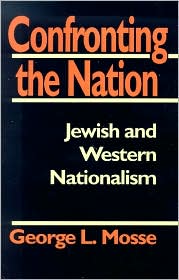
One of the best books that I read and reviewed last year was George L. Mosse’s “Fallen Soldiers: Reshaping the Memory of the World War” (1990) which discusses what he calls the cult of the fallen soldier, the emergent European nationalisms of the nineteenth century, and the impacts these factors had on the cultural experience of war. This book, written three years later, continues his discussion of the different kinds of nationalism in Europe, with a slight focus on Zionism in the last third of the book. While there are continuous concerns that are picked up and examined throughout, this reads more like twelve related essays instead of having a tightly unified thesis.
The first two essays, “National Anthems: The Nation Militant” and “National Representation in the 1930s in Europe and the United States,” discuss the ways in which nationalism chose its political accoutrements, its national anthems, ideological art, its flags; Mosse says that these collectively comprise a “political liturgy.” According to Mosse, “Both Italian fascism and the national socialism with their own flags, anthem, rites, and ceremonies created a civic religion which co-opted nationalist traditions. Here the civil religion of nationalism found expression through the rites and ceremonies of the fascist movements” (p. 58). He is deeply concerned with how these helped constitute a politics of self-representation and re-invention, and how it enabled the nation as the expression of a general will. He asks penetrating questions into why the European nationalisms that are so recognizable turned out to look so different from American nationalism, which Mosse identifies as embodied in the image of “the free-roaming, self-reliant young man,” “the quintessential symbol of the new nation. Cowboy heroes fighting nature and the Indians were young, virile, courageous, but not disciplined. Images of unspoilt nature were joined to individual courage and daring” (p. 38).
Mosse historically locates many of the precedents of fascism and nationalism in the French Revolution, which he says is one of the first instances in which there was a “concept of the general will, of the people worshipping themselves” (p. 74). The tie that links all of these phenomena is the nationalization and mobilization of the masses. “The creation of a political liturgy based upon the aesthetic of politics was a consequence of the belief in the artificial construct of ‘the people’ they had to be mobilized, shaped, and disciplined, and the way in which this was done was influenced – if not directly determined – by the French Revolution. The Revolution signaled the break between the old politics of dynasty and privilege, and the new democratic politics supposedly based on the will of the people” (p. 75). While most nationalisms harkened back to a volkish past ensconced in an immutable mythology of national or racial purity, Mosse’s essay “The Political Culture of Futurism” looks at how this artistic and literary movement embraced modernity instead of eschewing it. “This nationalism, then, was not weighted down by volkish ideals. It accepted technology and with it a new speed of time, using the forces unleashed by modernity in order to integrate men and nations. The political culture of futurism was expressed through a political style that sought to propel nationalism into modernity, to give it clarity and form without restraining its dynamic drive” (p. 96).
Another essay, “Bookburning and the Betrayal by the Intellectuals,” considers the May 10, 1933 bookburnings that occurred in dozens of German university towns, and asks the question “How did it come to this? Why did the middle-class intellectuals or ‘Bildungsburger’ burn their own books?” “The bookburnings must be understood as a fire of purification, of awakening, as analogies to the generation of 1914 made clear again and again. Successful mass movements cannot be inspired by negative symbols. The bookburnings were to represent a positive symbolic action within the bounds of the Third Reich” (p. 111). For Mosse, the betrayal of the intellectuals resulted from a “turning inward, the ideal of rebirth, of purification, the craving for eternal values, for being at one with the people, the primary importance of respectability, [and] the exclusion and isolation of the outsider” (p. 112).
The last five essays consider the ways in which Jews dealt with European nationalism after the Napoleonic emancipation, and especially the way Jews tried to carve a middle path between what Mosse calls “Bildung and respectability.” Bildung, at least as Humboldt put it in the early nineteenth century, was a philosophical and educational cultivation of the self sustained through cultural maturation, while respectability was almost a foregone conclusion for those Jews who wanted to be assimilated into the European mainstream and middle classes. These two pursuits might not seem necessarily contradictory, but with the rise of bourgeois values, Mosse seems to argue that they grew to be increasing at odds with one another. Even though Jewish culture had much more in common with liberalism (the pursuit of parliamentary government, for example), Mosse looks at how Jews conscripted some of the same ideas such as physical strength, purity, and nobility of spirit into their own nationalist ideas. For Herzl and Buber, for instance, “the civic religion of nationalism was not a call to battle but an educational process for the individual Jew who must recapture his dignity a human being” (p. 125). The last two essays look at the nationalist approaches of two important Zionist thinkers - Max Nordau and Gershom Scholem.
The only problem with this book, if one can call it that, is that this was only twelve essays, whereas Mosse could have easily written twelve books – and I would have read each one with relish. Each chapter is really just the barest tip of an iceberg into the scholarship, but together they serve as a grand introduction to nationalism as a set of ideas in the nineteenth and twentieth centuries, and how Jews reacted to, adopted, and used those nationalist ideals in various approaches to Zionist thought.
[The above video is mostly a
reading of the text below, with an occasional aside thrown in for good measure
as they strike me as relevant. I welcome questions, comments, or concerns about the material contained in
this video.]
More a collection of related essays and less a book with a coherent, unified message, this is a set of nine essays on a variety of topics. I’ll list them here just to give the reader some idea of the vast area these essays cover. They are “On the Fetish Character in Music and the Regression of Listening,” “The Schema of Mass Culture,” “Culture Industry Reconsidered,” “Culture and Administration,” “Freudian Theory and the Pattern of Fascist Propaganda,” “How to Look at Television,” “Transparencies on Film,” “Free Time,” and “Resignation.”
Like much of the writing that comes out of the Frankfurt School, this is heavily influenced by Marxism, especially their idea (Horkheimer collaborated with Adorno in writing some of the more important essays in this collection) that mass consumer culture has become commodified, reified, and fetishized. The “culture industry” refers to the processes of standardization, marketing, and distribution which become a part of objects themselves, and therefore indistinguishable from them. Everything has been subsumed under the logic of the mass market, which creates what Adorno and Horkheimer term “false needs” – those needs that capitalism invents, and that capitalism can uniquely satisfy.
What I found of particular interest with the idea of the culture industry was the resonance that it has with so many other critical thinkers like Baudrillard, Debord, Lyotard, and Marcuse, yet being written several years before the most important work of these thinkers (Baudrillard’s “Simulacra and Simulation” didn’t come out until 1981, Debord’s “The Society of the Spectacle” until 1967, and Lyotard’s “The Postmodern Condition” until 1979). Some of the essays in the second half of the book – “How to Look at Television” and “Transparencies on Film,” especially – reminded me explicitly of the best writing on media of Harold Innis, Marshall McLuhan, and Raymond Williams.
While I credit Adorno for being an innovative, insightful social critic, the orthodox Marxism can become a little laborious and grating after a few essays. The best of his thought isn’t a result of his Marxism at all, but rather his sociological and psychological observations, as is the case with most of the media criticism here. Whether it is the translation or the original writing, the style is at its worst overly turgid and obfuscating, which makes it only digestible in small doses, but Adorno seems like he is always worth the effort. I will probably come back to this again and again in an attempt to inform my readings of later Frankfurt School members, especially Fromm, Lowenthal, and Habermas.
[The above video is mostly a
reading of the text below, with an occasional aside thrown in for good measure
as they strike me as relevant. I welcome questions, comments, or concerns about the material contained in
this video.]
Jackson Lears’ “Something for Nothing” is an interesting and thought-provoking work written in the vein of social and cultural history, much like his “No Place of Grace,” now some thirty years old. It looks at a wide swath of subjects from gambling, the rise of the market, and various Native American and slave folk traditions related to chance and luck.
According to Lears, two contradictory forces have always been at the heart of American experience: that of the speculative confidence man who has his eye on “main chance rather than moral imperative” and the other which “exalts a disciplined self-made man whose success comes through the careful cultivation of Protestant values” (p. 3). He calls these two instincts the “culture of chance” and “culture of control” respectively. Even though the growth of Protestantism and especially Puritanism damaged a vernacular culture of luck (by trying to impose a Providential reason and rationality upon it, instead of allowing for the free flow of play embodied by Fortuna), the split between the elite idea that Providence was superior and the more popular, demotic idea of divination persisted throughout the culture. Lears looks at the cultural importations of African slaves and Indians that created complex social relations with whites. As John Greenleaf Whittier asked rhetorically in 1847 “Is it not strange that the desire to lift the great veil of the mystery before us should overcome, in some degree, our peculiar and most republican prejudice against color, and reconcile us to the necessity of looking at Futurity through a black medium?”
By the late eighteenth century, luck had become less providential and more secularized, and the idea that “misfortune fell upon the worthy as on the licentious” became more widespread. This is related to the American idea of secular reinvention, or as Martin Buber put it, “the grace of beginning again and ever again.” But as chance was secularized, it was simultaneously driven into the underbelly of society. There were gentlemen who took pride in their flirtation with luck for luck’s sake, while sharpers (that is, swindlers, gamblers, and confidence men) would cheat the game for a dollar. The bourgeois ethic of what Lears calls “evangelical rationality” demonized gambling, thereby giving rise to the “masculinity of moderation” and the domestication of gambling.
The last couple of chapters cover the increasing trends in Taylorism and bureaucratic rationality that Lears claims were always at odds with the cultural idioms of chance and fortune; still another covers how various thinkers, artists, and musicians used these ideas during the rise of Modernism. While Lears clearly roots on the side of chance for the entire book, he is intellectually honest enough to admit that neither side has definitely won a victory. In fact, our age, much like any other, might be ruled by the uneasy co-rule of both luck and control.
Lears is a superb historian and a professor at Rutgers who has gained considerable mastery over his sources; the body of scholarship that he draws from is impressive. However, the one major complaint I have about the book is that some of it is very repetitive: it seems like the idea of “luck versus control” pops up over and over again, sometimes with so little variation that it doesn’t really need recapitulation. This makes the first two-thirds of the book move very slowly, even though the last third picks up, though this may just have been because of the shift toward cultural toward a more narrow kind of intellectual history.
A note on my rating: for someone only passingly interested in this kind of history, I would only give it three stars; for someone with a less casual interest, I think it deserves another star. Most people will probably not enjoy this as beach reading; it’s not a popular history that the cover might have you think it is. However, if you’re interested in the topic, Lears handles it with a scholarly, thorough care that he has fostered throughout his career.
[The above video is mostly a
reading of the text below, with an occasional aside thrown in for good measure
as they strike me as relevant. I welcome questions, comments, or concerns about the material contained in
this video.]
“Explaining” religion has been a cottage industry within the field of anthropology at least since its academic institutionalization in the United States about a century ago. Pascal Boyer, the Henry Luce Professor of Individual and Collective Memory at Washington University in St. Louis, rejects almost all of these traditional explanations out of hand in the first chapter of his book, and not without reason. He says that all attempts to explain religious thought – the urge to explain the origin of the universe, the need to provide comfort or reassurance, a deliverance from mortality, the need to keep society together, or to provide an objective basis for morality – all fail in some important way. Unfortunately, what he offers in its place are convoluted, disorganized arguments, and the occasional ad hoc rationalization.
Boyer is an anthropologist himself, but is mostly dissatisfied with the reasons that classical anthropology has offered for the persistence of religious belief, as noted above. In “Beyond Belief,” he attempts to fuse the precepts of cognitive psychology with evolutionary theory, perhaps with a bit of sociobiology thrown in. His approach is one that is wholly rationalist and structuralist. In a sense these two terms are interrelated. “Rationalism” (and I use the word in the sense that philosophers word – that is, in opposition to empiricism) suggests that the human mind is built in such a way, of more elementary structures, which facilitate learning. This is not to say that we don’t learn from the world around us, as empiricists suggest; instead, it is an approach which assumes that the structure of the mind itself enables the acquisition of certain cognitive skills (language, belief, et cetera). Structuralism suggests that elements in a given domain – in this instance, religious belief – are impossible to understand without placing them in a larger, overarching system or structure (or “structuration,” as Roland Barthes and Claude Levi-Strauss were fond of saying.)
Boyer begins by discussing what supernatural concepts are like. He suggests that mental ideas are like templates. For example, we have the template of “animal” in our head, which might contain mini-ideas like “needs to eat,” “reproduces,” and “produces waste.” The thing about these templates is that they’re remarkably adaptable; we use these Big Idea templates to explain all living phenomena that we see. Boyer suggests that this template works because it’s structurally so close to the way religious (or supernatural) ideas, which change the template in one important way: they have one, and only one, idea in them that intuitively goes against everything else in the template. For example, the template “women” might include a lot of things, but “can have a child without having sex” isn’t one of them; similarly for the template of “man” and “rise from the dead” (both found in Christian theology). Psychological experiments have shown that stories with pedestrian details are difficult for people to retain, while the very rare fantastical element makes a story much more prominent in the memory, and this might have something to do with the persistence of certain supernatural beliefs. Or, as Boyer puts it, “the religious concept preserves all the relevant default inferences except the ones that are explicitly barred by the counterintuitive element,” and thus “a combination of one violation with preserved expectations is probably a cognitive optimum, a concept that is both attention-grabbing and that allows rich inferences” (p. 73 and p. 86, respectively).
Furthermore, the minds that create this series of rich inferences is the rule, not the exception. Boyer gives other kinds of intuitive understanding, like the physics of solid objects (which Boyer calls “intuitive physics”), physical causation, goal-directed motion, and an ability to link structure to function (p. 96-97). This takes us up through approximately the first third of the book.
Unfortunately much of the book is an utter mess as far as trying to present a cogent, coherent argument is concerned. From here on out, we get answers to chapter headings like “Why Ritual?”, “Why Gods and Spirits?”, and “Why is Religion About Death?” that do in fact provide answers, but seem to have no direct relevance to the questions raised in the first third of the book. Here and there, he will pick up the idea of the template, which he spent so long developing, but mostly ignores it in the formulation of arguments, if you can even grace the remainder of the book with so formal a name.
A saving grace of the book are what Boyer calls the progress boxes that are distributed throughout the book, which sum up the arguments in case you’ve lost the thread of his thought somewhere – a not unlikely prospect. The progress boxes are used liberally in the first part of the book, and appear nowhere in approximately the last two thirds except for pages 326-328, which constitute one big progress box that recapitulates the logic of Boyer’s entire approach. For someone interested in Boyer’s approach who doesn’t care to read the entire book, reading only the progress boxes probably isn’t a bad idea. They’ll leave you with the big ideas, and several of the more important details.
I appreciate this book for offering a fairly in vogue approach to a divisive, controversial topic. There are wonderful ideas here, like that of the template and how religious memes need to violate one intuitive idea on a template to be evolutionarily successful enough to be transmitted. I just wish Boyer would have been able to better follow the lines of his own logic, or tie the loose threads together into something more cohesive. He does provide a chapter-by-chapter section for further reading. Perhaps in one of these, a better exposition of these ideas can be found.
[The above video is mostly a
reading of the text below, with an occasional aside thrown in for good measure
as they strike me as relevant. I welcome questions, comments, or concerns about the material contained in
this video.]
This is one of the most bizarre books that I’ve read in a long time, and not only because it earnestly defends a point of view that can in many respects be called pre-modern, but because it does so in such a sophisticated way. Philip Rieff may be best known today for being the husband of Susan Sontag during the 1950s, and fathering David Rieff, who in turn became an established writer in his own right. He taught sociology at the University of Chicago (where he met and married Sontag after a very short courtship) and the University of Pennsylvania. He sustained a career-long attack on what he calls in this book and others “therapeutic culture,” which he expounded upon in earlier books including “Freud: The Mind of the Moralist” and “The Triumph of the Therapeutic.” This book wasn’t written by Rieff. He knew out of the cultural mainstream his ideas were, and even admitted that this kind of book “wouldn’t have a constituency.” Two of his sociology students, Aaron Manson and Daniel Frank, cobbled together some of the notes that Rieff made and this book is the result.
Another peculiar thing about this book is that, despite its cover and accessible introduction, it is essentially a book-length response to the sociology of Max Weber, and essentially his writing on the concept of charisma, to which contributions were influential. Rieff thinks that culture is thoroughly interdictory – that is, that it is built around negative demands made on the people of that culture. (Think, for example, of the Decalogue, with its liberal use of “Thou Shall Nots.”) In fact, life under Mosaic law is one of the examples that he discusses in particular detail. He calls cultures that recognize a common set of interdictory themes as “creedal cultures.” In fact, a culture’s creed is what makes it a culture in the first place; without a creed, there can be no culture. While Rieff never pinpoints a time in history, we as cultural animals (I assume he’s talking about Western European culture specifically here) began to question and eschew this interdictory motif. He largely blames this on the writings of Weber, but not only him: he also has some pretty harsh things to say about Kierkegaard and, of course, his favorite hobby horse, Freud. One of the biggest signs of an anti-credal cultural (not really a culture at all) is the changing nature of charisma. Charisma, Rieff claims, used to refer to the power of moral transformative moral authority; Moses and Jesus are two preeminent examples. Now when we hear the word charisma, we think of someone who has merely personal panache and appeal. The moral aspect of the word has been subtracted from its contemporary use. And again, this is all Max Weber’s fault.
None of this seems especially controversial. Every culture, even “liberal” ones (a word, as I show below, that Rieff bandies with never a dearth of disdain) have interdicts and prohibitions. Is there anyone that deny that our culture is not based on at least some interdictory forms? Don’t murder, don’t commit incest, don’t be a traitor to your country, et cetera, et cetera. But Rieff manages to say some pretty reactionary, and even anti-intellectual, things in the course of the book. Perhaps they might not seem too reactionary, considering what he thinks about the basis of culture, but I’ll let the reader judge. These are some of the passages that I highlighted from the first forty pages of the book.
“The modern guru [the charismatic in the modern sense] represents the ephemeral, the fugitive, the contingent. It is in this sense that he is an exemplar, someone to follow” (p. 4).
“Weber is himself the culminating expression, I think, of the Protestant pathos, which turns into evolutionism and progressivism, with its mystique of breaks with the established order as its highest expression of the intellect and of soul. This Protestant pathos, this mystique with breaks of the established order, is less than a revolution and more than a reform. It is that relentless lusting after progressive social change that characterizes the liberal era and leads straight into the Marxist pathos, with its generalized species man, who turns into an apparatchik and party functionary” (p. 7).
“It is the rejection of rejection, by transgressive movements, of the entire notion of dangerous situations that has become the special object of fear and hatred in modern society. The liberal defense of these transgressions must itself bring liberalism itself crashing down, for in that defense, the liberals are defending the destruction of avoidance mechanisms which are necessary to the practice of liberalism itself” (p. 12).
“Egyptian culture was the fixing of all possibility, including death, in certain forms. This is an entire society aspiring to be exactly as it is, in love with itself” (p. 17).
“The moderns of Israel, especially the literary moderns, have accepted the terrible idea that they themselves can become as gods, to other persons, especially in the sexual encounter. Thus, in the modern novel there is a vengeful destruction of all limits on the sexual relation, its utter transformation into a coming struggle for power between one person and another” (p. 18).
“For then men no longer grasp their own limits; they become destroyers and worship only under the principle of power, which can only be fulfilled by breaking up ritualization as defensive similitudes of power in the struggle against power. The cool, analytical rejection of ritual, as “uncivilized” and “irrational,” is one with the hot, romantic yearning to bring down the roof of civilization. The rationalist rejection of ritual is one element in the large compound of anti-culture. The other element is the deritualizing of intimate relations, the dissolution of all manners and reticence, so that men leap upon one another, to achieve their own persons in the submission, unto death, of another” (p. 19).
“Science needs its own Sabbatarian movement, an insistence upon what it is not to do, a time and sphere of constraint. The insoluble social condition of the scientists is that they are uncovenanted, without an interdictory form” (p. 25).
“The case histories for perversion that pass for modern literature and theater, by failing to transform private into public, are not art, but transgressive assaults upon the public, mounted in public. An anti-credal play could be a man opening his fly, and inviting an audience to do the same. In such an artistic condition, there can be no disobediences. No act needs justification because it means nothing whatever – like a Pinter play” (p. 37)
If any of these quotes appeal to you intellectually, then you’ll probably enjoy and agree with Rieff’s thesis, assuming that you’re willing to navigate his prose, which too often consists of elliptical bloviating. For committed liberals – and Rieff is so anti-liberal that this has nothing to do with the modern political usage of the word, but would include almost anyone who thought there was anything redeeming about the Enlightenment – his thesis is drawn in such overarching, bombastic language (as can be seen from the quotes) that your Weltanschauung will probably not be radically changed, but I found mustering the counterarguments to be fun and stimulating. In many ways, this book reads like it was written a century ago. I find it odd that people can still believe such things. But I’m glad I read this.