Showing posts with label Modern History. Show all posts

Friday, February 22, 2013

Review of Tony Judt's "Ill Fares the Land


[The above video is mostly a reading of the text below, with an occasional aside thrown in for good measure as they strike me as relevant.  I welcome questions, comments, or concerns about the material contained in this video.]


It has often been said that Americans know the value of everything and the worth of nothing. This book serves to historicize why precisely that is the case, and is also a clarion call extolling the virtues of social democracy. According to Judt, we need to completely re-think how we view our neighbors and human community.

Social democracy, as I said, is at the heart of the book, and Judt makes it quite clear that this isn’t just a generic term for liberalism. “They [social democrats] share with liberals a commitment to cultural and religious tolerance. But in public policy social democrats believe in the possibility and virtue of collective action for the collective good. Like most liberals, social democrats favor progressive taxation in order to pay for public services and other social goods that individuals cannot provide themselves; but whereas many liberals might see such taxation or public provision as a necessary evil, a social democratic vision of the good society entails from the outset a greater role for the state and the public sector” (p. 7). Note the terms “collective good” and “collective action.” They are at the center of reconceptualizing society in terms of something other than market share or a growing economy. Judt offers much evidence toward the beginning of the book showing how inequality – not wealth, but inequality – within a society is directly correlated with “infant mortality, life expectancy, criminality, the prison population, mental illness, unemployment, obesity, malnutrition, teenage pregnancy, illegal drug use, economic insecurity, personal indebtedness, and anxiety” (p. 18).

But matters didn’t always look so bleak. After the Great Depression and World War II, it quickly became the consensus economic opinion that the state had an integral role to play in keeping events like this from ever happening again. Judt is especially interested in the arguments and contributions of John Maynard Keynes here. The trust and cooperation of the interventionist state, largely the work of Keynes, provided England and the United States with security, prosperity, social services, and greater equality” (p. 72). For a generation, no one questioned that these ends were also public goods, or if they were questioned, they were by the most marginal of political figures.

What happened? Ironically, Judt lays much of the blame for the disintegration of the welfare state on the radical political movements of the 1960s, which he claims “rejected the inherited collectivism of its predecessor.” (Christopher Lasch similarly blames this set of movements in “The Culture of Narcissism” – a book which complements this one in subtle and complex ways.) Judt argues that social justice wasn’t central to the mission of liberal sixties activism. In fact, it even co-opted the rhetoric of fierce individualism; it was all about “doing your own thing” and “letting it all hang out.” 

This consequently left a vacuum into which Austrian economics and its various supporters could rush – Karl Popper, Ludwig von Mises, Joseph Schumpeter, Peter Drucker, and Friedrich Hayek. These men – all Austrians – were all profoundly influenced by the “introduction into post-1918 Austria state-directed planning, municipally owned services and collectivized economic activity” (p. 99). Of course, this attempt was a failure which seemed to leave a gigantic psychic wound on these thinkers and their future thought about the possibility of state interventionism or even short-term economic planning. Also, these men knew a Left that believed in human reason and (Marxist) historical laws whereas the Fascists acted, and acted violently. Judt therefore reminds us that most contemporary recapitulations of this debate are really just variations on this one-hundred year-old theme. 

The prominence of Austrian economics and neoliberal policies allowed for the ascendancy of Ronald Reagan and Margaret Thatcher, whose reigns saw a liquidation of much of the public sector in their respective countries during the 1980s. For Judt, these massive efforts at privatization were largely responsible for a loss of community and communal trust. We now live in our gated communities with closed-circuit cameras, terrified of our neighbors, rules by feckless, soulless politicians like Bill and Hillary Clinton (someone has to say it, so thank you, Tony), as well as Tony Blair and Gordon Brown. With people like these, it’s a small wonder why we’re so cynical about politicians and political efficacy. 

Judt ends the book with a call for both a renewed fervor for political dissent and the recasting of public conversation. Intellectuals used to be respected for broadcasting their unpopular opinions, but today that ability too seems to be enervated. Through a sheer act of moral will, we have to rediscover how to think through these issues and learn how to express disapproval in a country that has historically been incredibly conformist. 

To this end, we need to “think the state” and “think the community” in radically different ways, which means brushing away old shibboleths like “We all want the same thing, we just disagree on how to get there” and “You either believe in freedom or tyranny, capitalism or communism.” These slogans, so totally inculcated into popular political “thinking” and the gruel offered up by media pundits, should be recognized for what they are: simplistic and reductive, aimed at making one think that there are no middle ways, no third (or fourth, or fifth) options. Old habits are hard to slough off. Acts of pure imagination and appropriating the political world anew are terrifically difficult. But, at least according to Judt, now is the time.

Tuesday, January 15, 2013

Review of Mike Rapport's "1848: Year of Revolution"


[The above video is mostly a reading of the text below, with an occasional aside thrown in for good measure as they strike me as relevant.  I welcome questions, comments, or concerns about the material contained in this video.]


This is what you might call a “general interest” history of the events that occurred in Europe in 1848. What started in Sicily quickly spread all over Europe: to France, Germany, Austria, the Italian states, Demark, Wallachia, Poland, and several other places. While almost no structural or political change actually took place as a result of these revolutions and therefore they are usually considered somewhat of a failure, it is often thought to be the historical location of the birth pangs of several European nationalisms. 

And while some of the first European nationalists might be located here, they also may have been responsible for tearing the revolutions apart along ethnic and cultural lines, as Rapport also discusses. Revolutionaries had to build functional constitutions, often in the faces of monarchs who couldn’t be bothered with them, and avoid radical sectarianism – all in the name of getting something accomplished politically. Unfortunately because of all the countries and people that were involved, the book at times can seem like a rush to mention all of the important conflicts, places, and dates. Because the revolutionary dynamic is largely similar any place that Rapport is discussing, the conflicts run together. I also set this down several times for a few weeks on end, which couldn’t have helped with the reading comprehension and keeping things straight narratively. 

Rapport writes well enough, but he doesn’t really make it easy, or overly readable, or enjoyable, like he perhaps could have. To be honest, the book is hay-dry. I was going to say that the information was “well-presented,” but I don’t even know what that means in a book of history if it’s not engaging and reader-friendly. Unfortunately, as much as I learned, it’s neither one of those things. But I’ve always been one of those people that can’t just put a book down, even if I don’t like it at all. I really should try to fix that.

If anyone knows a better recounting of the 1848 revolutions, please feel free to share.

Monday, January 14, 2013

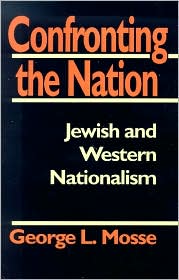
Review of George L. Mosse's "Confronting the Nation: Jewish and Western Nationalism"


[The above video is mostly a reading of the text below, with an occasional aside thrown in for good measure as they strike me as relevant.  I welcome questions, comments, or concerns about the material contained in this video.]


One of the best books that I read and reviewed last year was George L. Mosse’s “Fallen Soldiers: Reshaping the Memory of the World War” (1990) which discusses what he calls the cult of the fallen soldier, the emergent European nationalisms of the nineteenth century, and the impacts these factors had on the cultural experience of war. This book, written three years later, continues his discussion of the different kinds of nationalism in Europe, with a slight focus on Zionism in the last third of the book. While there are continuous concerns that are picked up and examined throughout, this reads more like twelve related essays instead of having a tightly unified thesis. 

The first two essays, “National Anthems: The Nation Militant” and “National Representation in the 1930s in Europe and the United States,” discuss the ways in which nationalism chose its political accoutrements, its national anthems, ideological art, its flags; Mosse says that these collectively comprise a “political liturgy.” According to Mosse, “Both Italian fascism and the national socialism with their own flags, anthem, rites, and ceremonies created a civic religion which co-opted nationalist traditions. Here the civil religion of nationalism found expression through the rites and ceremonies of the fascist movements” (p. 58). He is deeply concerned with how these helped constitute a politics of self-representation and re-invention, and how it enabled the nation as the expression of a general will. He asks penetrating questions into why the European nationalisms that are so recognizable turned out to look so different from American nationalism, which Mosse identifies as embodied in the image of “the free-roaming, self-reliant young man,” “the quintessential symbol of the new nation. Cowboy heroes fighting nature and the Indians were young, virile, courageous, but not disciplined. Images of unspoilt nature were joined to individual courage and daring” (p. 38). 

Mosse historically locates many of the precedents of fascism and nationalism in the French Revolution, which he says is one of the first instances in which there was a “concept of the general will, of the people worshipping themselves” (p. 74). The tie that links all of these phenomena is the nationalization and mobilization of the masses. “The creation of a political liturgy based upon the aesthetic of politics was a consequence of the belief in the artificial construct of ‘the people’ they had to be mobilized, shaped, and disciplined, and the way in which this was done was influenced – if not directly determined – by the French Revolution. The Revolution signaled the break between the old politics of dynasty and privilege, and the new democratic politics supposedly based on the will of the people” (p. 75). While most nationalisms harkened back to a volkish past ensconced in an immutable mythology of national or racial purity, Mosse’s essay “The Political Culture of Futurism” looks at how this artistic and literary movement embraced modernity instead of eschewing it. “This nationalism, then, was not weighted down by volkish ideals. It accepted technology and with it a new speed of time, using the forces unleashed by modernity in order to integrate men and nations. The political culture of futurism was expressed through a political style that sought to propel nationalism into modernity, to give it clarity and form without restraining its dynamic drive” (p. 96).

Another essay, “Bookburning and the Betrayal by the Intellectuals,” considers the May 10, 1933 bookburnings that occurred in dozens of German university towns, and asks the question “How did it come to this? Why did the middle-class intellectuals or ‘Bildungsburger’ burn their own books?” “The bookburnings must be understood as a fire of purification, of awakening, as analogies to the generation of 1914 made clear again and again. Successful mass movements cannot be inspired by negative symbols. The bookburnings were to represent a positive symbolic action within the bounds of the Third Reich” (p. 111). For Mosse, the betrayal of the intellectuals resulted from a “turning inward, the ideal of rebirth, of purification, the craving for eternal values, for being at one with the people, the primary importance of respectability, [and] the exclusion and isolation of the outsider” (p. 112).

The last five essays consider the ways in which Jews dealt with European nationalism after the Napoleonic emancipation, and especially the way Jews tried to carve a middle path between what Mosse calls “Bildung and respectability.” Bildung, at least as Humboldt put it in the early nineteenth century, was a philosophical and educational cultivation of the self sustained through cultural maturation, while respectability was almost a foregone conclusion for those Jews who wanted to be assimilated into the European mainstream and middle classes. These two pursuits might not seem necessarily contradictory, but with the rise of bourgeois values, Mosse seems to argue that they grew to be increasing at odds with one another. Even though Jewish culture had much more in common with liberalism (the pursuit of parliamentary government, for example), Mosse looks at how Jews conscripted some of the same ideas such as physical strength, purity, and nobility of spirit into their own nationalist ideas. For Herzl and Buber, for instance, “the civic religion of nationalism was not a call to battle but an educational process for the individual Jew who must recapture his dignity a human being” (p. 125). The last two essays look at the nationalist approaches of two important Zionist thinkers - Max Nordau and Gershom Scholem.

The only problem with this book, if one can call it that, is that this was only twelve essays, whereas Mosse could have easily written twelve books – and I would have read each one with relish. Each chapter is really just the barest tip of an iceberg into the scholarship, but together they serve as a grand introduction to nationalism as a set of ideas in the nineteenth and twentieth centuries, and how Jews reacted to, adopted, and used those nationalist ideals in various approaches to Zionist thought. 

Review of Modris Ekstein's "Rites of Springs: The Great War and the Birth of the Modern Age"


[The above video is mostly a reading of the text below, with an occasional aside thrown in for good measure as they strike me as relevant.  I welcome questions, comments, or concerns about the material contained in this video.]


Much ink has been spilled in trying to locate the fons et origo of modernism, and Modris Eksteins is not the first historian to suggest that it occurred on or about the evening of May 29, 1913 at the Paris premiere of Stravinsky’s “Le Sacre du Printemps.” Eksteins’ social history, however, is as thoroughly compelling as any, re-introducing you to characters in both the balletic production, but also the broader cultural mise-en-scène: the eccentric Diaghilev and Nijinsky, the founding of the Ballets Ruses. The totally arrhythmic music, the spasmodic modes of dance, the wildness of that May night was far too much for the audience. “The ballet contains and illustrates many of the essential features of modern revolt: the overt hostility to inherited form; the fascination with primitivism and indeed with anything that contradicts the notion of civilization; the emphasis on vitalism as opposed to rationalism; the perception of existence as a continuous flux and a series of relations, not as constants and absolutes; the psychological introspection accompanying the rebellion against social convention” (p. 52). Had this primitivism been wholly confined to the stage, it may not have caused the outright riot that it did that night. But in many ways, the performance was symbolic of a number of other paradigm shifts in culture and politics which can be seen as leading up to the Great War.

While it begins with no political concerns, “Rites of Spring” does move on to all the territory you would expect of a book with the subtitle “The Great War and the Birth of the Modern Age.” The unification, industrialization, and modernization of Germany is synthesized nicely with the more explicitly cultural effects this wrought – the rise of a certain vitalistic German idealism, especially seen in the eminent German social critics of the time, an increasing prevalent Kulturkampf, and the eschewal of what was perceived as the weak, bourgeois liberalism of the French and English. Not only did many Germans seek out a kind of Nietzschean transvalutation of values, but they saw this as inseparable from their innovative modes of warfare, especially toxic gas and submarine technology, which they saw as attempts to assert the superiority of the German Geist. (For a fuller treatment of these particular themes, see Fritz Stern’s excellent “Politics of Cultural Despair: A Study in the Rise of Germanic Ideology.”)

The sections “Reason in Madness” and “Sacred Dance” discuss the extreme effects that trench warfare wrought on soldiers, painting a stark picture of the origin of the term “shell shock.” Feelings, sympathy, and memories couldn’t survive on the battlefield; failure to expurgate them would lead to insanity. Just as he tried to delouse himself as regularly as possible,” wrote Jacques Riviere, “so the combatant took care to kill in himself, one by one, as soon as they appeared, before he was bitten, every one of his feelings. Now he clearly saw that feelings were vermin, and that there was nothing to do but to treat them as such.”

Eksteins also talks about disillusionment, which he claims, believably, never took hold in Germany during the War as it did in England and France. Where it did exist, it was much more common among the civilians than the fighting soldiers, though “the language and literature of disillusionment would on the whole be a postwar phenomenon – everywhere.” Literature describing the permanent psychological effects on soldiers is much older than the Great War, but it is rarely given the important consideration that Eksteins gives it. 

One of the most compelling vignettes here is Eksteins’ extended re-telling of Lindbergh’s transatlantic flight in May, 1927. Contemporaries saw his feat as a point of historical torsion, enabling both a revival of the imagination, a rebirth of individualism, and Dionysian will. But it was also a sign for all that was gone and would never be regained. “Freedom was no longer a matter of being at liberty to do what is morally right and ethically responsible. Freedom had become a personal matter, a responsibility above all to oneself. The modern impulse before the war had possessed a strong measure of optimism, springing from a bourgeois religion of meliorism. That optimism had not disappeared entirely by the twenties, but it was now more wish than confident prediction. Its landscape was one of destruction and desolation, not simply the barrenness that the avant-garde had so despised before the war” (p. 267).

Review of Richard Overy's "The Twilight Years: The Paradox of Britain Between the Wars"


[The above video is mostly a reading of the text below, with an occasional aside thrown in for good measure as they strike me as relevant.  I welcome questions, comments, or concerns about the material contained in this video.]


To read this, you would think that to live in England during the years between the two World Wars, you needed two Venlafaxine a day. Of course the First World War caused tremendous amounts of grief and worry, and threw the national and imperial economies of Europe into a tailspin. But Richard Overy paints a picture of a people who thought that they were the only bastion of civilization. They barely survived one total war. They lived for an entire generation thinking that another one would bring total ruination to everything holy, pure, and good. “The Twilight Years” looks at a wide range of topics, but this looming nihilism about chances for the future and its sure doom if another war was to rear its ugly head, are constant themes which fully inform all aspects of the book.

Several topics are traced here, starting with the dominant historiography of Western Europe during this time, namely the writings of Spengler and Toynbee, both of whose thoughts about history were colored by cyclical periods of cultural growth and renewal followed by eventual decadence and decline. Others thought that World War I was the symbolic end for capitalism, illustrating how it was now an unsustainable economic system and needed to be replaced with either Communism or something else; these ideas were prevalent on both the sides of the political spectrum.

What was one to do, then, in order to save culture from the barbarians trying to throw us headlong into another war? An ethos of cautious preservation and social utopia – the titular paradox - coexisted simultaneously. Eugenics was very much in vogue, especially by those who considered themselves members of the progressive Left, and felt that “weeding out” members of society who were not as physically or mentally fit was the obligation of the government if society was to continue on. Furthermore, everyone was in favor of both positive and negative eugenics. (Positive eugenics is aimed at encouraging reproduction among the genetically advantaged, while negative eugenics is aimed at lowering fertility among the genetically disadvantaged, including abortions and forced sterilizations.) One woman Overy mentions, a highly enthusiastic supporter of eugenics of all kinds by the name of Marie Stopes, disinherited her own son upon his announcement that he had married a woman who wore eyeglasses, thinking that she might pass her myopia onto their own children. 

This was also the time when Freudian psychoanalysis was just beginning to both splinter off into its sub-schools (Adlerian, Jungian, et cetera), and when Freud started to become a household name. It was seen as just as big a panacea as eugenics, another eight ball to tell whether human nature was inherently good or evil. The answer was sure to predict whether or not another war would be inevitable. Not surprisingly, the “scientific” research into these questions yielded only inconclusive results. Political partisans would use it for their own advantage, hawks thinking that war was a part of the human condition, and pacifists thinking that it wasn’t. Pacifism and all of its various incarnations all over England take up a sizeable part of the book, only fading well into the 1930s when percipient observers knew that it would take nothing short of war to stop Hitler and fascism. It was fascinating to see who hung on, though, and for how long. Aldous Huxley, for example, remained an ardent pacifist even as Hitler was invading Poland. 

As others have noted, this isn’t so much a social or intellectual history as it is a “history of mentalities,” mostly informed by the thought of the dominant, educated classes of the time. For all of the possibly divisive material, I didn’t detect any noticeable biases on Overy’s part. It’s clear and accessible for anyone with even a minimal background in the subject, and doesn’t assume too much of the reader in the way of the minutiae of English politics. For those interested in these smaller details, he provides a useful introduction called “Britain 1919-1939: A Chronological Introduction,” which gives foreign policy details, a list of prime ministers, and a note on the economy. All in all, this is a superb book for anyone interested in the very historically specific worries, anxieties, and preoccupations of England during the twenties and thirties. 

Review of Frederick Brown's "For the Soul of France: Culture Wars in the Age of Dreyfus"


[The above video is mostly a reading of the text below, with an occasional aside thrown in for good measure as they strike me as relevant.  I welcome questions, comments, or concerns about the material contained in this video.]


If you thought that the Dreyfus Affair was the fons et origo of anti-Semitism in France, or that the Kulturkampf was just a phenomenon relegated to Bismarck’s imperial Germany, this book may just very well be the place to begin a solid education in late nineteenth-century French cultural history. Brown assumes a minimal knowledge of the politics of the time (First Empire, Second Republic, Third Empire, et cetera), but provides a useful chronology at the beginning of the book and adds just enough political background to keep the narrative both clear and engaging. The use of the words “culture war” in the subtitle is by no means a cynical ploy to attract readers, either. The words and the politics to which they give so theatrical a birth were just as relevant then as they ever have been.

The tug-of-war between Catholicism and the allied forces of modernity, science, and secularism sandwiched between the times of Louis-Philippe and Napoleon III dominate the book. Any vignette to begin with would have admittedly been arbitrarily chosen, but Brown’s choice of the 1863 publication of Ernst Renan’s “La Vie de Jesus” (“The Life of Jesus”) serves as a terrific and illustrative point of departure for a book whose major themes include Renan’s strident anti-clericalism. 

Brown also includes a couple of stories that are unfortunately little-known in the United States, but that give hints of the growing violence and division that is to come. He tells of the Union Generale, an investment syndicate launched by aristocratic, pro-Catholic associates that went on to build railroads all over Europe. Due to rampant speculation and financial impropriety on the part of the man who ran the operation, it suffered a tremendous failure – also known as the Paris Bourse crash – in January, 1882. Perhaps not surprisingly considering the events to come, the first people to be blamed were the Jews. We get detailed chapters of the building of the Panama Canal and the 1897 fire at the Charity Bazaar as well, but the heart of the book is a 55-page long chapter on perhaps the one event – or rather a long, complex series of events – that is familiar to all Americans: the Dreyfus Affair. 

Woven together, these bits of history provide one of a few tapestries that really are essential for understanding the French history of this period. For someone unfamiliar with the major names and events, I recommend Robert Gildea’s “Children of the Revolution: The French, 1799-1914,” which provides much of the political background that Brown can’t cover in a brief 265 pages. Brown has a tremendous grasp of the source material. I highly recommend this to readers looking for a great bridge between popular and more formal academic history regarding this period. Reading this makes me want to pick up the Brown’s Flaubert biography that I have on my shelves – or anything else that I can find by him.