Showing posts with label Historiography. Show all posts

Saturday, April 6, 2013

Review of Michael Ann Holly's "The Melancholy Art"


[The above is mostly a reading of the text below, with an occasional aside thrown in for good measure as they strike me as relevant.  I welcome questions, comments, or concerns about the material contained in this video.]
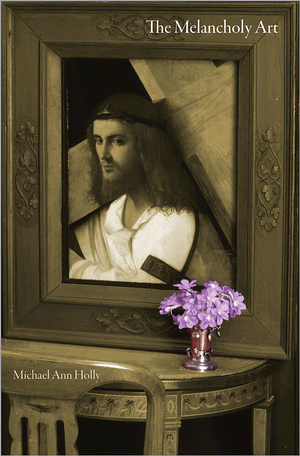

In “The Melancholy Art,” Michael Ann Holly charts an entire constellation of concerns in relation to art-historical (and art-historiographical) writing. Her grasp of philosophy, critical theory, and psychoanalysis is every bit as sophisticated as her grasp of art history (her area of formal academic training). It takes a certain kind of pensiveness and humility to criticize your entire field – for that’s partially what this book sets out to do – with Holly’s active, voracious, but always judicious, interdisciplinarity.

First, a note on the book itself. I ordered the hardback edition directly from Princeton. It has an especially beautiful cover with a close-up of Giovanni Bellini’s “Christ Carrying the Cross.” The book is printed on thick, glossy paper with a generous number of black-and-white reproductions, ranging from Freud’s couch in Vienna to a picture of Reimenschneider’s “Altar of the Holy Blood.” Whoever put the book together was smart in seeing how the format and design of the book could wonderfully sing in tandem with its actual content.

The content is just as beautiful. It’s a collection of five highly interrelated essays, all centering around the intimacy, existential quality, and experience of the aesthetic with an emphasis on how these have been treated in art history writing in the past. At its heart, these essays are meant to, as I said above, criticize in several penetrating ways some contemporary assumptions about art history and the writing of it. Holly argues that art history has an unfortunate inclination toward overt positivism that focuses on analytical reconstruction, and often has a wonderful self-confidence that it can completely and totally represent the work in question, its content, context, and significance; these assumptions will be familiar to anyone familiar with nineteenth-century historiography. 

Holly suggests our art-historical encounter with objects is just as full of melancholy, loss, displacement, and gaps that can never be fully bridged – and, most importantly, that acknowledging this will make for a truer, more authentic historiography. She quotes Frank Ankersmit’s “Sublime Historical Experience”: “How we feel about the past is no less important than what we know about it – probably even more so” (p. 7). The object relations theory of Melanie Klein is used to smartly situate the experience all art historians find themselves in: analyzing and attempting to reconstruct something ( i.e., Klein’s “object”) that is inevitably lost and unable to be reconstructed. 

Above all, I think Holly is concerned with making the writing of art history phenomenologically and existentially rigorous, to reinvigorate it with a kind of élan vital that positivism saps from it, and that only a pensive melancholy can even partially restore. She wants art historians to recognize loss for what it is and for what it means, instead of trying to cheaply paper over it with the meretricious claims of sentimentalism. Above all, art historians must know that their task is an impossible one: that of working toward a goal that can never be fully completed or realize. We will always have something to say about that diptych, or this altarpiece. Meaning abides and never exhausts itself – and this is the source of our melancholy. 

Holly quotes one of Whitney Davis’ articles on Winckelmann, a quote more than deserving of full repeat here, for it sums up the entire spirit of Holly’s project: “The history of art is lost, but art history is still with us; and although art history often attempts to bring the object back to life, finally it is our means of laying it to rest, of putting it in its history and taking it out of our own, where we have witnessed its departure. To have the history of art as history - acknowledging the irreparable loss of the objects – we must give up art history as a bringing-to-life, as denial of departure. If it is not to be pathological, art history must take its leave of its objects, for they have already departed anyway” (p. 21). 

If I have one small criticism of the book, it is that she does not seem to recognize the expansiveness of its implications. I quoted her quoting Frank Ankersmit above, not an art historian but a historiographer, so she knows that these ideas have already been touched upon. Dominick LaCapra, Hayden White, Cathy Caruth, and other historiographers have written on similar topics. However, while acknowledging her intellectual debts, she makes unique contributions of her own, but never applies them outside of art history, when they are extremely applicable. Without ever becoming insular, she keeps the explicit implications for her work within the realm of art history, and the result is a work of undiminished thoughtfulness, rigor, and melancholy in its own right.

Tuesday, January 15, 2013

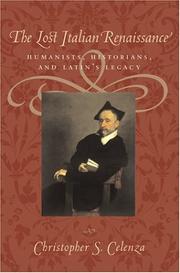
Review of Christopher S. Celenza's "The Lost Italian Renaissance"


[The above video is mostly a reading of the text below, with an occasional aside thrown in for good measure as they strike me as relevant.  I welcome questions, comments, or concerns about the material contained in this video.]


For some reason, I have lately been the lucky recipient of numerous academic catalogues, especially from university presses that are having sales with as much as 75% off. One of the more recent ones, from Johns Hopkins, had this in it, and for a mere five dollars. It might have been better-suited for someone more thoroughly steeped in the formal study of the Italian Renaissance than I can admit to being, but what it had to say about the current state of study in this area was interesting. It certainly couches many of the problems of contemporary Italian Renaissance studies in interesting ways, and makes the reader privy to a lot of “insider” information. In this book, Celenza is mostly concerned with the formation and current state of Renaissance studies, and particularly the effects that certain sources (or lack thereof) have wrought upon that study.

“The Lost Italian Renaissance” is more a series of interconnected essays on a group of related themes than it is a book with a continuous argument. The first essay argues that twentieth-century Italian Renaissance studies seriously suffers from a lack of sources that were originally written in Latin for a number of reasons, but mostly because scholars from the previous (that is, the nineteenth) century thought that non-vernacular languages were of at most secondary importance (mostly because of the rise of nationalist conceptions of history, like that of Herder). Because of this, many of the most important sources in Latin have still not been sourced, recorded, and critically edited for the sake of posterity. The second chapter discusses two contemporary scholars in the field, Eugenio Garin and Paul Oskar Kristeller, their approaches to comparative historiography, and how they each contributed to a rediscovery of these important Latin manuscripts. 

The rest of the book tries to construct an approach to the Italian Renaissance by looking at philosophical approaches to history including the synchronic and diachronic and looking at the way individual thinkers, including Claude Levi-Strauss and Richard Rorty, have thought about these problems. The last chapters try to build case studies in model intellectual history upon the ideas he has offered. He uses one essay to compare Lorenzo Valla to Marcilio Ficino, and the next to look at how traditional ideas of honor in the Italian Renaissance were tied to notions of masculinity and gender construction. 

I would recommend this to anyone with a formal, academic interest in this area. I felt that I definitely would have learned more had I been more familiar with some of the problematic aspects of what Celenza was talking about, including the contributions of Eugenio Garin and Paul Oskar Kristeller. 

Review of Martin Jay's "Songs of Experience: Modern American and European Variations..."


[The above video is mostly a reading of the text below, with an occasional aside thrown in for good measure as they strike me as relevant.  I welcome questions, comments, or concerns about the material contained in this video.]


The last five hundred years of Western philosophy have been beguiled by the notion of “authentic experience,” and especially how it has been cordoned off from the sensorium of the human mind. In a highly worthy addition to the history of ideas, Martin Jay aims to examine several “modes of experience” – the religious, aesthetic, historical, postmodern among them – so that we might better understand how this precarious category has been understood throughout the history of western thought.

Jay begins immediately by distinguishing between the two large, general types of experience called Erlebnis (which is immediate pre-reflective, and personal) and the Ehfahrung (based on sensual impressions and cognitive judgments). In one of the most interesting parts of the book, Jay details how Michel Montaigne reconfigures experience from a set of powers embodied in the human mind to a set of frailties and weaknesses which delimit those powers, hence his famous quip that “to philosophize is to learn how to die.” Montaigne’s subjective interiority of experience was radically changed during the Scientific Revolution in which the scientific method externalized and objectified sensory data, creating a public sphere of inquiry which had never been in place before the seventeenth century. The chapter progresses as a précis of Western philosophical traditions, with everything from Bacon’s emphasis on observation to Kant’s positing of a noumenal world that is the “raw material” for our transcendental faculties to feast upon.

Jay then turns to a chapter about the “Appeal of Religious Experience,” an examination of Schleiermacher, James, Otto, and Buber. He reads Schleiermacher, as most historians have, as a substantive response to Kant, a sort of anti-Enlightenment personalism, which was continued by the likes of Buber and Otto. His readings of these figures, and his knowledge of the secondary material is extensive to such a degree that he can deftly portray the history of ideas not as something that comes down from “on high,” but as a Great Conversation (how old-fashioned is that?) 

“History and Experience” explores some of the more popular trends in nineteenth- and twentieth century historiography, including Dilthey’s distinction between Naturwissenschaften and Geisteswissenschaften (arguably the distinction that launched modern historiographical discourse as we recognize it today), along with the ideas of Collingwood, Joan Wallach Scott, and Franklin Ankersmit. Collingwood’s “The Idea of History” will inevitably be familiar to most, but the Scott and Ankersmit were new to this reader. Scott (coincidently the mother of New York Times film critic A. O. Scott) questions one of the most fundamental assumptions of all historians – the idea of the constituted subject who can entertain historical experience. Instead of taking for granted the idea of the knowing subject upon whom experience impinges itself (as had been done automatically by thinkers from Descartes to Kant), Scott argues the interpretative regimes of the historian are built, a la Foucault, not through a neutral intellective apparatus, but rather are shaped by, and in turn themselves shape, historical events. Franklin Ankersmit offers a subjective historiography of immediacy which blurs the lines between knower and known. 

As the book proceeds into Bataille, Foucault, Adorno, and Benjamin, Jay detects a substantive disappearance of experience (at least experience as we have known it before) largely historically situated in the World War I and the years immediately thereafter. This renders the tone of the final chapters into something of a threnody for something lost.

Monday, January 14, 2013

Review of Peter Gay's "Freud for Historians"


[The above video is mostly a reading of the text below, with an occasional aside thrown in for good measure as they strike me as relevant.  I welcome questions, comments, or concerns about the material contained in this video.]


“Freud for Historians” is the third book of a trilogy that began with “Style in History” (1974) and “Art and Act” (1976). In the earlier books, Gay used some unchallenged assumptions of his field, and therefore used the third book in order to explain the basis for his historical methodology. Gay is a psychohistorian – that is, a historian whose work is consciously influenced by the work of Sigmund Freud, specifically psychoanalysis. He has quite rightly perceived Freud to be under attack from many corners, not least from academic historians, and uses this book to explain how Freud can shed some light on the historical experience and human psychological understanding when used intelligently. 

Gay notes that historians have had a curious aversion toward psychohistory. He makes a strong case that, besides just a simple recounting of events, historians also need a way of discussing the motivations, passions, desires, and needs of historical actors. Where to look for a model? While historians have been reluctant to appropriate Freud, this, he argues is far from their only problem: even some of the most accomplished historians have also misunderstood, deliberately distorted, or even lied about him in their academic work. 

“What psychoanalysis can bring to the assessment of past experiences is a set of discoveries and a method – fallible, incompletely tested, difficult to apply yet, I am persuaded, the best we now have to register the broken surfaces and sound the unplumbed depths of human nature” (p. 77). Gay concedes that much of the problems might be Freud’s reputation as a monolithic, reductive determinist (“biology is destiny”) who leaves no room for the complexities of class, culture, or other variables in individual lives. But he makes a tight and compelling case that a sophisticated reading of Freud mitigates against these assumptions; furthermore, psychoanalysis was never meant to be handed down by the Founding Father as a set of unassailable dictates. Instead, while Freudian drives are seen by critics as being the sole factors of influence, all historians import a psychology into their work to describe “persistent human wishes, gratifications, and frustrations.” While Freud can be used as a valuable heuristic, this by no means lessens the capacity for culture and other environmental factors to affect human agency. 

Gay might be best known for his five-volume history called “The Bourgeois Experience: From Victoria to Freud,” one volume of which (“The Cultivation of Hatred”) I read several years ago. I remember thinking it was an odd project, and certainly a kind of history with which I was completely unfamiliar; the Freudianism seemed out of place, and I felt a little embarrassed for Gay for importing such stuff into his work. However, reading this, the arc of his life’s work makes much more sense. If someone were to ask me what I think of Freud, my response may very well be a function of the time of day and my mood instead of my objective knowledge of his work. However, the capaciousness of Gay’s intellect and his refusal to grow complacent within his chosen tradition had me constantly rooting him on while reading this. His is a model for cultural and intellectual work, and this is a fine apologia for those interested in opening up new historical byways.