Showing posts with label Art History. Show all posts

Thursday, September 5, 2013

Review of E. M. Gombrich's "The Story of Art"


[The above is mostly a reading of the text below, with an occasional aside thrown in for good measure, as they strike me as relevant.  I welcome questions, comments, or concerns about the material contained in this video.]


Just a dozen or so pages into this book, I knew that it was one I wish I would have had access to when I was first seriously exposed to art. While in many respects, it is a conservative textbook (being first published in 1950), it is fundamentally meant for someone who has little to no previous formal contact with art history. Of course, if you have some, this can make you seriously engage some of your previously held assumptions about what you like and why you like it, but I got the distinct impression while reading that it was meant to initiate a teenager – a teenager who very much reminded of me of myself – into a whole new world. 

The inclusions and exclusions of certain artists are, of course, always arbitrary. However, Gombrich’s choices do not deviate too much from a standard art history text. What particularly drew me to the book was what I perceived to be its inordinate focus on medieval and especially Renaissance art. Of the twenty-eight chapters included in the book, about five mostly focus on Western medieval images (6 and 8-11). Another six chapters (13-18) focus on the art of the Western Renaissance. Most surveys of art history to which I had been previously exposed paid scant attention to medieval art and they sometimes did not give the Renaissance the space that I felt it deserved. There is no doubt the medieval and Renaissance art Gombrich’s pet periods here (and, admittedly, they’re mine, too.) 

What makes it so special is that, instead of spending the first chapter in an abstract exercise of thinking about what “Art” is, he forces you over and over again to take the art on its own terms. While discussing the various visual perspectives painted by the artist of “The Garden of Nebamun,” he says: “To us reliefs and wall-paintings provide an extraordinarily vivid picture of life as it was lived in Egypt thousands of years ago. And yet, looking at them for the first time, one may find them rather bewildering. The reason is that the Egyptian painters had a very different way from ours of representing real life. Perhaps this is connected with the different purpose their paintings had to serve. What mattered most was not prettiness but completeness. It was the artists’ task to preserve everything as clearly and permanently as possible. So they did not set out to sketch nature as it appeared to them from any fortuitous angle” (p. 60). It is the occasional insight like this that makes the book most worthwhile for a neophyte. After all, how many of us have measured something we saw by the standards of our particular narrow time and place? He really drives home the point that thinking about art seriously means thinking about other perspectives (both literally and figuratively), other preoccupations, and other aesthetic modus operandi. This is a lesson that should be lost on none of us, about art, or about anything else.

Saturday, April 6, 2013

Review of Michael Ann Holly's "The Melancholy Art"


[The above is mostly a reading of the text below, with an occasional aside thrown in for good measure as they strike me as relevant.  I welcome questions, comments, or concerns about the material contained in this video.]


In “The Melancholy Art,” Michael Ann Holly charts an entire constellation of concerns in relation to art-historical (and art-historiographical) writing. Her grasp of philosophy, critical theory, and psychoanalysis is every bit as sophisticated as her grasp of art history (her area of formal academic training). It takes a certain kind of pensiveness and humility to criticize your entire field – for that’s partially what this book sets out to do – with Holly’s active, voracious, but always judicious, interdisciplinarity.

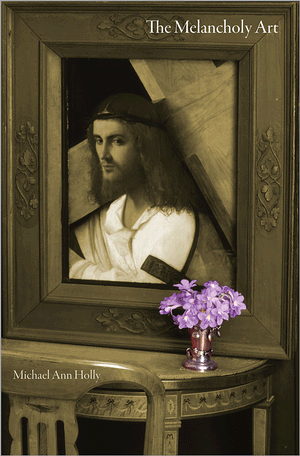
First, a note on the book itself. I ordered the hardback edition directly from Princeton. It has an especially beautiful cover with a close-up of Giovanni Bellini’s “Christ Carrying the Cross.” The book is printed on thick, glossy paper with a generous number of black-and-white reproductions, ranging from Freud’s couch in Vienna to a picture of Reimenschneider’s “Altar of the Holy Blood.” Whoever put the book together was smart in seeing how the format and design of the book could wonderfully sing in tandem with its actual content.

The content is just as beautiful. It’s a collection of five highly interrelated essays, all centering around the intimacy, existential quality, and experience of the aesthetic with an emphasis on how these have been treated in art history writing in the past. At its heart, these essays are meant to, as I said above, criticize in several penetrating ways some contemporary assumptions about art history and the writing of it. Holly argues that art history has an unfortunate inclination toward overt positivism that focuses on analytical reconstruction, and often has a wonderful self-confidence that it can completely and totally represent the work in question, its content, context, and significance; these assumptions will be familiar to anyone familiar with nineteenth-century historiography. 

Holly suggests our art-historical encounter with objects is just as full of melancholy, loss, displacement, and gaps that can never be fully bridged – and, most importantly, that acknowledging this will make for a truer, more authentic historiography. She quotes Frank Ankersmit’s “Sublime Historical Experience”: “How we feel about the past is no less important than what we know about it – probably even more so” (p. 7). The object relations theory of Melanie Klein is used to smartly situate the experience all art historians find themselves in: analyzing and attempting to reconstruct something ( i.e., Klein’s “object”) that is inevitably lost and unable to be reconstructed. 

Above all, I think Holly is concerned with making the writing of art history phenomenologically and existentially rigorous, to reinvigorate it with a kind of élan vital that positivism saps from it, and that only a pensive melancholy can even partially restore. She wants art historians to recognize loss for what it is and for what it means, instead of trying to cheaply paper over it with the meretricious claims of sentimentalism. Above all, art historians must know that their task is an impossible one: that of working toward a goal that can never be fully completed or realize. We will always have something to say about that diptych, or this altarpiece. Meaning abides and never exhausts itself – and this is the source of our melancholy. 

Holly quotes one of Whitney Davis’ articles on Winckelmann, a quote more than deserving of full repeat here, for it sums up the entire spirit of Holly’s project: “The history of art is lost, but art history is still with us; and although art history often attempts to bring the object back to life, finally it is our means of laying it to rest, of putting it in its history and taking it out of our own, where we have witnessed its departure. To have the history of art as history - acknowledging the irreparable loss of the objects – we must give up art history as a bringing-to-life, as denial of departure. If it is not to be pathological, art history must take its leave of its objects, for they have already departed anyway” (p. 21). 

If I have one small criticism of the book, it is that she does not seem to recognize the expansiveness of its implications. I quoted her quoting Frank Ankersmit above, not an art historian but a historiographer, so she knows that these ideas have already been touched upon. Dominick LaCapra, Hayden White, Cathy Caruth, and other historiographers have written on similar topics. However, while acknowledging her intellectual debts, she makes unique contributions of her own, but never applies them outside of art history, when they are extremely applicable. Without ever becoming insular, she keeps the explicit implications for her work within the realm of art history, and the result is a work of undiminished thoughtfulness, rigor, and melancholy in its own right.

Tuesday, March 5, 2013

Review of Michael Kammen's "Visual Shock: A History of Art Controversies in American Culture"


[The above video is mostly a reading of the text below, with an occasional aside thrown in for good measure as they strike me as relevant.  I welcome questions, comments, or concerns about the material contained in this video.]


“Visual Shock” purports to be nothing less than a history of art controversies in American culture. Its scope is extensive, dating all the way back to the beginning of the nineteenth century and the construction of the Washington Monument, coming up through the more recent contretemps over work of Robert Mapplethorpe and Andres Serrano. The chapters are organized topically, and cover much of the ground that you would expect such a comprehensive history to deal with: the introduction of modern art into the United States, public sculpture, murals, the politicization of art and art funding, and even changing aspects of American museology. 

One of the problems with the book is that whole libraries have been written on any one of these subjects. Reading Kammen’s book, I was reminded of a distinction all too familiar to computer scientists: that of data and information. Data is raw, unprocessed, unfiltered, and if some serious work isn’t done on it, pretty useless. Information on the other hand, has had some sort of heuristic applied to it in such a way that it now can communicate something important. Unfortunately, Kammen’s book is all data and almost no information.

The sheer number of names, projects, commissions, provincial politicians, and kvetching letters to the editor that the reader encounters is impressive enough. You get quick, superficial accounts of Karen Finley, Judy Chicago’s famous “Dinner Party,” Chris Ofili, the huge metal pieces of Richard Serra, the bombastic denunciations against modern art by McCarthyist Michigan Congressman George Dondero, the protest art of the sixties and seventies, and the palpable drive for museums to put on more and more extreme exhibits, often sacrificing the quality of art shown, for the sole purpose of pulling in more money. Most of these take up perhaps a few pages – barely enough to introduce the reader to the piece being considered - before Kammen moves on to something else that catches his attention. 

Even given Kammen’s distracting lack of narrative drive and insistence on including everything under the sun, there are some recurring themes and questions. When should taxpayer dollars be expended on art, and when shouldn’t they be? Should nudity or the “ability to offend” a section of the viewing public have any relevance to this question? (Kammen, to his credit, does include some interesting polling of the general public on these questions, but as with most everything else, he covers it breathlessly in a few sentences and quickly moves on.) He also discusses several commissions during the Great Depression, and some of the factors that determined how the public reacted to them – this was one of the most successful parts of the book. 

One is left with the underwhelming and unsurprising conclusion that most of the public is at best befuddled and at worst disgusted by modern art. However, instead of building critically on that observation or going one step beyond what any relatively informed reader could have already told you, he leaves it there. The level of analysis or integrative thought behind the whole project is sorely lacking, which goes back to what I said about data and information earlier. Writing a book like this consists just as much in knowing what you’re not going to include as what you are, and that filter just doesn’t seem to be there. 

On a more prosaic note, in the early chapters, pictures are included when necessary – for those of you who can’t visually conjure Hiram Powers’ “The Greek Slave” from memory (I know some of you are out there). However, Kammen also refers to the work of several names I mentioned above, and no pictures are included. Perhaps he couldn’t get the relevant artist’s or museum’s permission, but this is too sizable an oversight in a book that deals with art, much of which the reader may never have seen. For both this reason and others discussed above, it may be best to completely overlook this unless you’re looking for the most general, cursory discussions of the topic. And even then, I’m sure you can find something better than this.