[The
above video is mostly a reading of the text below, with an occasional aside
thrown in for good measure as they strike me as relevant. I
welcome questions, comments, or concerns about the material contained in this
video.]
“There are occasions when silence no longer suffices, when it may pass as an avowal. Then one must not hesitate. Not only must one deny one’s true opinion, but one is commanded to resort to all ruses to deceive one’s adversary. One makes all the protestations of faith that can please him, one performs all the rites one recognizes to be the most vain, one falsifies one’s own books, one exhausts all possible means of deceit.” – Arthur Gobineau, from ‘Religions and Philosophies of Central Asia’
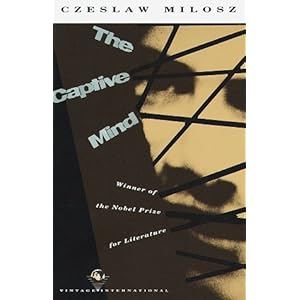
“The Captive Mind,” written in the early 1950s immediately after Milosz was awarded political asylum in France, is one of the first attempts to articulate the appeal of Communism (or, more broadly, dialectical materialism) to the intellectuals all over Eastern Europe.
Central to the novel are four characters identified by Milosz only as Alpha, Beta, Delta, and Gamma (but who we know enough about to identify as the very real authors Jerzy Andrzejewski, Tadeusz Borowski, Jerzy Putrament, and Konstanty Ildefons Gałczyński.) Each of the four has uniquely different relationships to writing, and thinks differently about the way dialectical materialism affects their writing. In Alpha’s youth, his far-right politics calls him into writing with the force of “moral authority.” He later eschews these politics and becomes a Catholic who speaks out against anti-Semitism. After World War II ends, Alpha’s writing ideologically aligns itself with the puppet governments that set themselves up on Eastern Europe, and he is later seen only seen as a literary prostitute by his former friends. Beta, a poet who spent two years in Auschwitz and Dachau only to later be released by American soldiers, later swallows the pill of Murti-Bing and writes hard-line ideological defenses of Leninism and Stalinism. The experiences of Delta and Gamma are equally typical accounts of when the mind of an intellectual bumps into an intractable ideological system which inevitably evolves into “ketman,” meaning an outward acceptance of an idea while still holding on to unspoken reservations. In fact, this word, originally from the Arabic, was imported into English by Arthur Gobineau himself (see the quotation above).
The first two chapters are incisive in evoking the spirit of the Communism-addled writer who struggles to balance his “priorities.” But the middle chapters on the writers seem as untrue – not false in the strict sense, but lacking the clarity of the moral-political-aesthetic themes with which he was trying to deal - as the ideology with which they are struggling. While they are presented as individuated, personal characters, the reader gets the feeling that Milosz is to turn them into archetypes while at other times working deliberately against this, which has an odd way of turning them into alienating abstractions for the reader.
Perhaps most of all, this book serves as a tocsin. By now, an entire generation of Europeans has had the ability to write, think, and speak publicly about whatever they wish, the very fact of which possibly renders Milosz’s book a peculiar curio from the doldrums of intellectual history. For many Americans, whose questions of freedom are restricted to whether or not one is allowed to burn their draft card or a Koran, or utter a prayer in school, reading “The Captive Mind” may very well have a stultifying effect. If that happens, the book runs the risk – we all run the risk – of it becoming still even more relevant than it is now.
“The Captive Mind,” written in the early 1950s immediately after Milosz was awarded political asylum in France, is one of the first attempts to articulate the appeal of Communism (or, more broadly, dialectical materialism) to the intellectuals all over Eastern Europe.
Central to the novel are four characters identified by Milosz only as Alpha, Beta, Delta, and Gamma (but who we know enough about to identify as the very real authors Jerzy Andrzejewski, Tadeusz Borowski, Jerzy Putrament, and Konstanty Ildefons Gałczyński.) Each of the four has uniquely different relationships to writing, and thinks differently about the way dialectical materialism affects their writing. In Alpha’s youth, his far-right politics calls him into writing with the force of “moral authority.” He later eschews these politics and becomes a Catholic who speaks out against anti-Semitism. After World War II ends, Alpha’s writing ideologically aligns itself with the puppet governments that set themselves up on Eastern Europe, and he is later seen only seen as a literary prostitute by his former friends. Beta, a poet who spent two years in Auschwitz and Dachau only to later be released by American soldiers, later swallows the pill of Murti-Bing and writes hard-line ideological defenses of Leninism and Stalinism. The experiences of Delta and Gamma are equally typical accounts of when the mind of an intellectual bumps into an intractable ideological system which inevitably evolves into “ketman,” meaning an outward acceptance of an idea while still holding on to unspoken reservations. In fact, this word, originally from the Arabic, was imported into English by Arthur Gobineau himself (see the quotation above).
The first two chapters are incisive in evoking the spirit of the Communism-addled writer who struggles to balance his “priorities.” But the middle chapters on the writers seem as untrue – not false in the strict sense, but lacking the clarity of the moral-political-aesthetic themes with which he was trying to deal - as the ideology with which they are struggling. While they are presented as individuated, personal characters, the reader gets the feeling that Milosz is to turn them into archetypes while at other times working deliberately against this, which has an odd way of turning them into alienating abstractions for the reader.
Perhaps most of all, this book serves as a tocsin. By now, an entire generation of Europeans has had the ability to write, think, and speak publicly about whatever they wish, the very fact of which possibly renders Milosz’s book a peculiar curio from the doldrums of intellectual history. For many Americans, whose questions of freedom are restricted to whether or not one is allowed to burn their draft card or a Koran, or utter a prayer in school, reading “The Captive Mind” may very well have a stultifying effect. If that happens, the book runs the risk – we all run the risk – of it becoming still even more relevant than it is now.