Showing posts with label Modernism. Show all posts

Monday, October 20, 2014

Review of Natsume Soseki's "Kokoro"


This novel, one of Natsume Soseki’s last and written on the cusp of Japan’s epochal rise to becoming a world power, reflects the author’s preoccupation with conflicting cultural attitudes in the transition from the feudalist Late Tokugawa Shogunate to the capitalist, more modernized Japan it would become during the Meiji Restoration. Of course, this period wasn’t just marked with bureaucratic, political, and military reforms; it also trickled down into the personal lives, families, and friendships, and this intensely personal impact is what Soseki looks at here.

“Kokoro” tells the story of a narrator who sees a man walking down a beach one day; he eventually befriends this man who we only come to know as “Sensei.” The development of their relationship and growing friendship forms the first part of the book’s tripartite structure. The narrator repeatedly emphasizes his own naiveté in contrast with the worldliness and cynicism of Sensei. Sensei is a guarded man who is old enough to work but chooses not to (we never get the impression that this is out of laziness), has few close friends, and doesn’t wear his emotions on his sleeve. While the innocent young narrator initially sees Sensei as the stereotypical older wise man, he slowly begins to realize that he has something unique to teach him. 

When the Emperor dies, his beloved General Nogi commits junshi, ritual suicide after the death of one’s feudal lord or master. Being a man of the old Tokugawa era, this act evokes more of a reaction in the Sensei than it does in the younger narrator – another sign that Soseki is telling the story of a generational and cultural divide. When Sensei sees General Nogi kill himself out of loyalty for the Emperor, he realizes that he doesn’t feel comfortable in this new Meiji dispensation, with the “modern age, so full of freedom, independence, and our own egotistical selves.” 

The second part, “My Parents and I,” sees the narrator’s father’s health start to decline, which leaves his future as a very recent college graduate very uncertain. He and his brother are both curious about what the will has in store for them, but the recent manner in which General Nogi died brutally underscores the new era’s selfish interest in material things. The last part consists of a very long letter that Sensei wrote to the narrator before he too decides to commit suicide. We learn of his youth, his family, and an episode during his time as a student (that I won’t reveal here) that ties together all the facets of Sensei’s personality and finally completely reveals who he is. 

Throughout the novel, the prose is spare, sharp, lean, and clear. Even Sensei’s voice, in his extended letter, varies very little stylistically from that of the narrator. This spare quality adds a sense of quiet distance between the reader and the story, which perhaps for more harmonious reflection. The language may just be the product of a particularly good translation, but I found the writing well suited to describing the characters and the Soseki’s themes: human frailty, the inevitability of the culture clash, the unrelenting quality of modernity, and confrontation with one’s troubled youth.

Wednesday, September 4, 2013

Review of George Cotkin's "Reluctant Modernism: American Thought and Culture 1880-1900"


[The above is mostly a reading of the text below, with an occasional aside thrown in for good measure, as they strike me as relevant.  I welcome questions, comments, or concerns about the material contained in this video.]

This volume, the fourth in the Twayne Modern American Thought and Culture series edited by Lewis Perry and Howard Brick, looks at American intellectual history from 1880-1900. Cotkin covers this ground adeptly and even-handedly, from the pervasive influence of Darwinism on practically every area of human endeavor of the time to the ambiguous place of the woman in intellectual life. The book has its weak points, which I will mention at the end. 

The first part of the book is the best and offers some of the clearest insights, though Cotkin never really does get to the heart of the matter in attempting to define what modernism actually is for him. He uses the metaphor of a “tangled bank” – the same one that Darwin used in another context to describe nature. The themes are familiar ones: how our subjects are continually buffeted to and fro between moribund Victorianism and the new, ambiguous, questioning modernism. Cotkin does a superb job of detailing how far-reaching are the ideas of progress, often espoused in the guise of Darwinism. Even the leading liberal religious thinkers of the time – Henry Ward Beecher, Newman Smyth, Octavius Brooks Frothingham – co-opted the idea of progress to create a theology that ministered to the particularly Victorian (not modern) worldview. Former orthodoxy started to become laced with aspects of rationalism, but not necessarily for the scientific pretense it provided; in fact, more often than not, this aspect of religious thought devolved into a calming anodyne for the complacent middle class, an appeal to their fetishization of progress. He covers Pragmatism, that fresh American philosophical tradition, very well, including how its professionalization also led to the development of psychology as its own academic discipline. Even in the realm of psychology the freedom versus determinism debate comes up again, with William Graham Sumner firmly on the side of passively accepting Nature’s laws, while William James suggests there is room for human volition.

In one chapter, Cotkin does a fine job in detailing the perhaps not terribly surprising extent to which racism dominated the fields of academic anthropology and ethnology. Lewis Henry Morgan’s work with the Iroquois and John Wesley Powell’s involvement with the U.S. Geological Survey are also indicative of the search for parallelism, order, and logic that Cotkin has already illustrated. Naïve optimism was not relegated to the middle-class, however. As James C. Wellington of Columbian College said, “There is a limitless vista opened (though not an absolutely unlimited one) for the prospective working of better laws, purer justice, wiser economics, richer science, and higher morality.” By the end of the century, as the influence of Franz Boas grew, anthropology began to slowly slough off its former assumptions and found that “the contextual understanding of culture … was complex and inexact.” 

The second half of the book provides information that is just as interesting, but much more derivative. I was introduced to some new names – Frances Benjamin Johnston and Gertrude Kasebier – but the background story has been told much more effectively elsewhere. In the closing chapters, Cotkin touches on the growth of American consumerism, and gives a few quick and insightful sketches of Stephen Crane, Louis Sullivan, Thorstein Veblen, and Edgar Saltus. 

For an undergraduate student who is looking for a quick overview of the reigning ideas of the time, this book is perfectly sufficient. The first half is worth reading all the way through for the interesting undercurrents of rationalism and progress Cotkin develops, but the second half should serve mostly as biographical reference material.

Tuesday, January 15, 2013

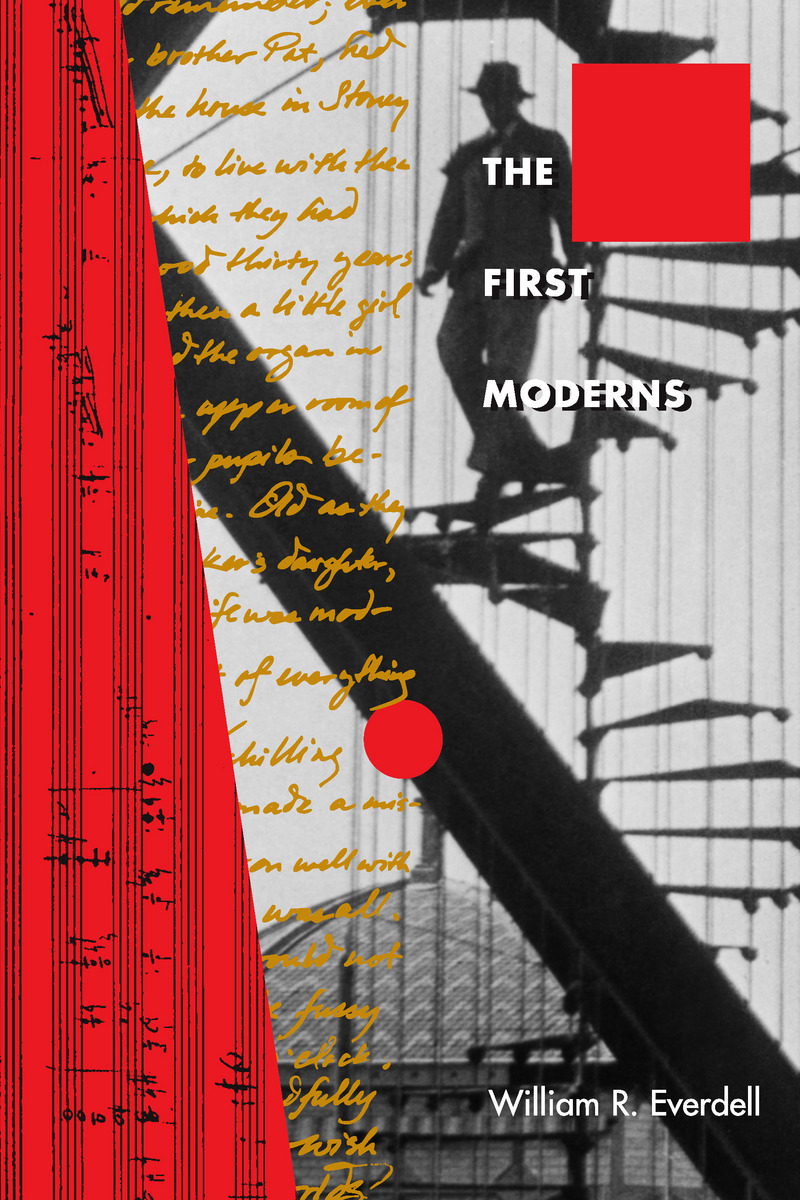
Review of William R. Everdell's "The First Moderns" | Dedicated to Michał


[The above video is mostly a reading of the text below, with an occasional aside thrown in for good measure as they strike me as relevant.  I welcome questions, comments, or concerns about the material contained in this video.]


Books of intellectual history with this size and scope are always difficult to talk about. I’ve read some that were abysmal failures, while others were highly successful. If I had to place this one along a spectrum, it’s certainly close to the latter for a couple of reasons. First, a point which has nothing to do with the quality of the book itself, but that I admire nonetheless: it was written not by an academic with narrow scholarly interests, but a wonderfully eclectic generalist, William Everdell, who has taught in the Humanities Department at St. Anne’s School (yes, a private high school) in Brooklyn for the last forty years. There’s something about the passionate amateur that I’m perennially attracted to. I don’t think we have enough of them. 

“The First Moderns” is good not only for what it covers just as well as other related books of intellectual history, but also because it covers a lot of relatively new territory. We know the usual suspects: Einstein, Rimbaud, Whitman, Russell, Kandinsky, Schoenberg, Strindberg, Picasso, and several dozen others. The names of Edwin Porter, Santiago Ramon y Cajal, and Valeriano Weyler, however, usually don’t make it into books of this kind. Do people even recognize these names anymore? Everdell also widens the scope of the book by covering not only names, but topics that usually don’t get mentioned. We are used to hearing Modernism defined in terms of music, philosophy, and the visual arts. Very rarely do we see mathematics and science discussed, let alone the invention of the concentration camp. 

The theme into which Everdell successfully manages to fit most of his vignettes is that of discreteness, continuity, and discontinuity. One doesn’t ordinarily think of something like mathematics as being potentially Modernist, but the discussion of Georg Cantor, Richard Dedekind, and Gottlob Frege makes wonderful sense in this context. They explored topics like infinity (actually, infinities), set theory, and the theoretical fundamentals of the field, including questions like, “What is an integer?” All of this work blurred the traditional lines of continuity and discontinuity that earlier logic and mathematics had felt so confident with. We also get a wonderful and highly intelligent, though non-technical, account of Ludwig Boltzmann’s work with statistical mechanics and his defense of atomism. If matter is made of atoms – millions of them – how do we discover anything about a concept as abstract as “energy”? Everdell details the ways in which Boltzmann invented new mathematical tools to think about energy and entropy as statistical averages of extremely complex states. The work of Boltzmann and the people after him showed how, when multiplied by trillions and trillions, tiny, individual discrete atoms can have physical properties en masse like temperature, energy, or entropy (which are all, in fact, related to one another). Again, we see how the information about discontinuous atoms can in fact yield useful information about matter when thought of as continuous. 

And even when we get lessons from art history, or music, or poetry with which we are perhaps almost familiar, Everdell adds new contexts, new names, and new layers that enable each chapter in the book to potentially morph into a book of its very own. He gives a beautiful account of Seurat’s invention and exploration of pointillism, the “invention” of blank verse with Whitman, Rimbaud, and Jules Laforgue, and a whole chapter on Hugo de Vries’ discovery of the gene and Max Planck’s introduction of quantum theory.

Books like this, in their inexhaustible attempt to explain what a concept (like Modernism) might mean to wide swaths of human experience and creativity inevitably can be as a bit listy. “He was important … and so was this, but don’t forget her…” et cetera, and Everdell hasn’t fully escaped that here. But if that bothered me, I would never read this kind of book – a kind of book which I love very much. I read this sort of stuff to learn about new connections between ideas they already knew of, and I can handle the narrative jumpiness if the information is presented in an intelligent way, and Everdell is certainly the kind of intellectual cicerone who is going to teach you something fascinating. If you’re interested in this time period and intellectual history as a field, I would recommend William M. Johnston’s “The Austrian Mind: An Intellectual and Social History, 1848-1938.” To be honest, it’s dry as hay and not nearly as interesting as Everdell’s book, but his sense of curiosity and the amount of sheer information covered is truly impressive. It complements the information in here nicely.

Monday, January 14, 2013

Review of Modris Ekstein's "Rites of Springs: The Great War and the Birth of the Modern Age"


[The above video is mostly a reading of the text below, with an occasional aside thrown in for good measure as they strike me as relevant.  I welcome questions, comments, or concerns about the material contained in this video.]


Much ink has been spilled in trying to locate the fons et origo of modernism, and Modris Eksteins is not the first historian to suggest that it occurred on or about the evening of May 29, 1913 at the Paris premiere of Stravinsky’s “Le Sacre du Printemps.” Eksteins’ social history, however, is as thoroughly compelling as any, re-introducing you to characters in both the balletic production, but also the broader cultural mise-en-scène: the eccentric Diaghilev and Nijinsky, the founding of the Ballets Ruses. The totally arrhythmic music, the spasmodic modes of dance, the wildness of that May night was far too much for the audience. “The ballet contains and illustrates many of the essential features of modern revolt: the overt hostility to inherited form; the fascination with primitivism and indeed with anything that contradicts the notion of civilization; the emphasis on vitalism as opposed to rationalism; the perception of existence as a continuous flux and a series of relations, not as constants and absolutes; the psychological introspection accompanying the rebellion against social convention” (p. 52). Had this primitivism been wholly confined to the stage, it may not have caused the outright riot that it did that night. But in many ways, the performance was symbolic of a number of other paradigm shifts in culture and politics which can be seen as leading up to the Great War.

While it begins with no political concerns, “Rites of Spring” does move on to all the territory you would expect of a book with the subtitle “The Great War and the Birth of the Modern Age.” The unification, industrialization, and modernization of Germany is synthesized nicely with the more explicitly cultural effects this wrought – the rise of a certain vitalistic German idealism, especially seen in the eminent German social critics of the time, an increasing prevalent Kulturkampf, and the eschewal of what was perceived as the weak, bourgeois liberalism of the French and English. Not only did many Germans seek out a kind of Nietzschean transvalutation of values, but they saw this as inseparable from their innovative modes of warfare, especially toxic gas and submarine technology, which they saw as attempts to assert the superiority of the German Geist. (For a fuller treatment of these particular themes, see Fritz Stern’s excellent “Politics of Cultural Despair: A Study in the Rise of Germanic Ideology.”)

The sections “Reason in Madness” and “Sacred Dance” discuss the extreme effects that trench warfare wrought on soldiers, painting a stark picture of the origin of the term “shell shock.” Feelings, sympathy, and memories couldn’t survive on the battlefield; failure to expurgate them would lead to insanity. Just as he tried to delouse himself as regularly as possible,” wrote Jacques Riviere, “so the combatant took care to kill in himself, one by one, as soon as they appeared, before he was bitten, every one of his feelings. Now he clearly saw that feelings were vermin, and that there was nothing to do but to treat them as such.”

Eksteins also talks about disillusionment, which he claims, believably, never took hold in Germany during the War as it did in England and France. Where it did exist, it was much more common among the civilians than the fighting soldiers, though “the language and literature of disillusionment would on the whole be a postwar phenomenon – everywhere.” Literature describing the permanent psychological effects on soldiers is much older than the Great War, but it is rarely given the important consideration that Eksteins gives it. 

One of the most compelling vignettes here is Eksteins’ extended re-telling of Lindbergh’s transatlantic flight in May, 1927. Contemporaries saw his feat as a point of historical torsion, enabling both a revival of the imagination, a rebirth of individualism, and Dionysian will. But it was also a sign for all that was gone and would never be regained. “Freedom was no longer a matter of being at liberty to do what is morally right and ethically responsible. Freedom had become a personal matter, a responsibility above all to oneself. The modern impulse before the war had possessed a strong measure of optimism, springing from a bourgeois religion of meliorism. That optimism had not disappeared entirely by the twenties, but it was now more wish than confident prediction. Its landscape was one of destruction and desolation, not simply the barrenness that the avant-garde had so despised before the war” (p. 267).