Showing posts with label Medieval History. Show all posts

Tuesday, September 3, 2013

Review of Lynn White's "Medieval Technology and Social Change"


[The above is mostly a reading of the text below, with an occasional aside thrown in for good measure, as they strike me as relevant.  I welcome questions, comments, or concerns about the material contained in this video.]

At the heart of some of the best works on medieval history rests the claim that the middle ages were not the dark, backward theocracies of popular lore, but dynamic societies full of art, culture, music, and science. And with the advent of Lynn White’s 1962 book “Medieval Technology and Social Change,” we can add technology to the list of subjects that have been sadly left off the list of subjects usually associated with this time period. 

White looks at the advent of what he considers to be three seminal technological innovations: the stirrup, the agricultural revolution of the early middle ages, and the rise of mechanical power in the late middle ages. Furthermore, White claims that he has two other intentions, to “show the kinds of sources and the means which must be used if the unlettered portions of the past (which involve far more than technological history) are to be explored” and to demonstrate “long before Vasco de Gama, the cultures of the eastern hemisphere were far more osmotic than most of us have believed. To understand the sources and ramifications of developments in medieval Europe one must search Benin, Ethiopia and Timor, Japan and the Altai” (v). At least according to the title, he also wants to outline the kinds of social impacts this had on the people who were dealing with the technologies in question. For a book of a mere 134 pages, this is a really ambitious project.

I always try to rate and comment on a book for what it claims to be and for what it is instead of what I want it to be, but there is much more of a focus on the “medieval technology” here than there is on the “social change,” by a large margin. The first essay provided a seamless integration of many of the areas listed above, including how the stirrup was related to the rise of a professional cavalry in the Frankish military, and how in turn that was related to the development of feudalism. The second and third case studies, however, rather quickly veer into the minutiae of agriculture and mechanical design, respectively. The transition from two-field to three-field crop rotation and a somewhat detailed account of the contents of Konrad Kyeser’s “Bellifortis” are details I could have lived without. And even though White explicitly mentions that he wants to trace the historical origins of these innovations, many essay subsections feel overly listy and superficial instead of honing in on the European focus that he seems to be most interested in here. A thorough history of these developments would have been interesting – for someone else, not for me – but it would have needed a much, much longer book. 

I didn’t come to this because of interest, but because it was cross-referenced in another book I’m currently reading about the ideas of Ernest Gellner, and specifically his “Plough, Sword, and Book.” I thought I recognized White’s name, and after looking on my bookshelf found that I owned it and decided to read it. There are, I am sure, people who will find this endlessly fascinating. Bless their souls. It may even still even be highly relevant in its field; I now know about as much about medieval technology as I did before I read it, i.e., next to nothing, though that wasn’t the book’s fault. For what it’s worth, you can still find this book on many graduate-level course syllabi covering the middle ages, the history of science, and even politics. But unless you are interested in the arcana of the technology in question, and especially tracking said technology from continent to continent, and from one medieval treatise to the next, I recommend another book on the subject. 

Tuesday, January 15, 2013

Review of Matthias Becher's "Charlemagne"


[The above video is mostly a reading of the text below, with an occasional aside thrown in for good measure as they strike me as relevant.  I welcome questions, comments, or concerns about the material contained in this video.]


Charlemagne is unique in being one of a set of historical figures whose best biographers write short, pithy, insightful works about them. Einhart's "Vita Karoli Magni," contemporaneous with Charlemagne, set the model. Notker Balbulus' "Gesta Caroli Magni," written later in the ninth century, set begin a long trend of mythologizing Charlemagne's role in Frankish history. This volume, a very serviceable contribution by Matthias Becher, adds to this "tradition of brevity," while never falling into Notker's tendency to apotheosize. 

The story begins on Christmas Day of the year 800, when Pope Leo III crowned Charlemagne "Emperor of the Romans," an event which will lay the formation for the rise of medieval Europe. In a Europe where the Roman Emperor had been gone for centuries, how was it that Charlemagne had consolidated the disparate Merovingian territories into a united Frankish kingdom? This question is at the heart of the book. 

When Charlemagne's father, Pippin the Short died, he left Charlemagne and his brother Carloman I as co-emperors. After just a few years of rule, however, Carloman died unexpectedly at the age of twenty, leaving his older brother as the sole ruler from 771 until his death 43 years later. Becher covers many of the most interesting topics of Charlemagne's reign in detail: the conquering of the Saxons, Avars, and Bavarians, the political influence of Leo III, his vastly influential educational reforms (due in part to his brilliant librarian at Aachen, Alcuin), and changes in ecclesiastical structure. Becher ends the discussion with "Epilogue: Hero and Saint," discussing how Charlemagne's complex role in Frankish history has been taken up by historians over the past twelve centuries, from Notker to Ranke.

This book, along with Einhart and Notker, serve as a wonderful introduction to Charlemagne's life and times. For the more sophisticated student who wishes to fill in the gaps left by these three accounts, Rosamond McKitterick's much more extensive "Charlemagne: The Formation of a European Identity" comes highly recommended. 

Review of Michael Frassetto's "The Great Medieval Heretics: Five Centuries of Religious Dissent"


[The above video is mostly a reading of the text below, with an occasional aside thrown in for good measure as they strike me as relevant.  I welcome questions, comments, or concerns about the material contained in this video.]


More than perhaps any other time, the average person of the European middle ages found their identity bound up in religious and moral norms. In this book, Michael Frassetto discusses what can happen when some thinkers pushed the boundaries of traditional religious understanding, and were eventually branded as "heretics." What is particularly special about this text is that the author does not present the heresies compartmentalized from their social context; rather, he integrates apropos aspects of the cultural and political milieu so that the reader fully understands how they came about, the purposes they serve, and, inevitably, the nature of their demise. 

The modern mind ties the word "heretic" to a sort of radical libertinism that flirts with godlessness and amorality. As Frassetto explores the varies heresies of the Church, we found out that most of these vanguards attacked the Catholic Church (I say "Catholic Church" here since all of the heresies explored herein are very much pre-Reformation, though one could argue that they had influences on Luther and Calvin) from "the other side." They claimed the Church was too materialistic, too worldly, that it had lost touch with God and His ways. In a word, many of these heresies were conservative in nature, in the sense that they wished to conserve an older worldview of godly purity, apostolic holiness, and in many cases, vows of extreme poverty. The only change these thinkers wanted to impose was to erase the all-too-worldly influences that the Church had grown complacent in and with. 

So, who are the fascinating people that Frassetto talks about? Each chapter tells the story of one or two heretics, or discusses a movement they were tied with. Discussed herein are Bogomil, Stephen and Lisois (leaders of a sect at Orleans), Henry the Monk, Peter Waldo (associated with the Waldensians), Raymond VI of Toulouse and his connection with the Cathars, Pierre Autier, Fra Dolcino, Marguerite Porete, John Wycliffe, and Jan Hus. 

Henry the Monk of Lausanne (fl. 1110 - 1148), hardly a heretic by today's standards, preached a return to apostolic poverty, saintliness, and orthodoxy, and spoke out against the Church's worldliness. And while the life of Peter Waldo (c. 1140 - 1218) very much resembled the lives of other now-canonized saints, his emphasis on self-imposed poverty and the importance of lay preaching rendered him a danger in the opinion of the Third Lateran Council. The stories of John Wycliffe and Jan Hus, whose names are probably most recognizable to those interested in the topic, portend the later religious wars of the sixteenth and seventeenth centuries. 

Because each chapter tells the self-contained story of a movement over a relatively short period of time, this book makes for an interesting and handy reference book, as well as fascinating reading for those wishing to gain a rudimentary understanding of heterodox religious thought on the periphery of the Church during the first half of the second millennium. This comes especially recommended for those interested in the historical development of the Catholic Church and anyone interested in medieval history. Nota Bene: As should be deduced from the size of this book (it is a rather slim volume), this is not a scholarly text. It is one that introduces material on the beginner to intermediate level, though a list of more specific monographs are listed in the back in an extensive bibliography. 


Review of Louise Collis' "Memoirs of A Medieval Woman: The Life and Times of Margery Kempe"


[The above video is mostly a reading of the text below, with an occasional aside thrown in for good measure as they strike me as relevant.  I welcome questions, comments, or concerns about the material contained in this video.]


Louise Collis' book stands of the interesting tradition of "books that are about books." While Kempe (c. 1373 - 1438) wrote what is quite possibly the first autobiography in the English language - and quite a fascinating book in its own right - Collis' re-telling of the story adds the occasionally much-needed and very helpful narrative voice of a twentieth-century historian. At the same time, her voice is never intrusive, always letting Margery's story shine through any additional insight she might have. 

Margery Kempe was born in or around the year 1373 to one John Brunham, the long-time mayor of Lynne (now King's Lynn) in Norfolk. In 1393, she would marry John Kempe and have her first child quickly thereafter. It was around this time when Margery had her first ecstatic religious vision when, according to her, Jesus appeared to her in a purple robe. Thirteen more children would follow over the years. 

One day, while lying in bed with her husband, she has another vision, she tells John that she has decided to give up her sex life with him in order to give herself fully to God. This was one of the larger decisions that was made on the way to her becoming a fully repentant saint, whose spiritual ablutions and contrition would irritate many of the people that used to love her the most. In 1414, she took a dangerous trip to the Holy Land (the threats of vagabonds and brigands made long-term travel much more of an adventure than we could ever imagine it today), returning home a year later; in 1417, she took a pilgrimage to Santiago de Compostella. Both of these trips are beautifully detailed in the text. During her travels, she was hardly able to control her grippingly emotional visions. While today we would imagine that everyone would admire her for such religious fervor, many of the people that she would encounter on her travels thought that she was either being histrionic and sanctimonious, or possessed by the devil. 

There is absolutely no doubt that Margery was a brilliant woman. While unlettered, she knew enough about Church dogmatics to defend herself when she was accused by some of being a Lollard (a follower of John Wycliffe). On other occasions, she was accused of being a heretic of other stripes, but always received commendations from those in a position to say what was orthodox and what wasn't. 

While the comparatively secular modern mindset might find Margery's religious devotion neurotic or overly compulsive, Collis' careful and considerate explication enables the reader to approach the text with more cultural and sociological sensitivity. No one would ever accuse Margery of being an uncomplicated woman. She was strong-willed and adamantine. But her sincerity, selflessness, and refusal to compromise those values which she found most important make her oddly likeable, and one of the more interesting religious figures to come out of early fifteenth century English religious history. 

This book comes highly recommended for those interested in religious (auto)biography, the history of the Catholic Church, or English history on a larger scale. 

Monday, January 14, 2013

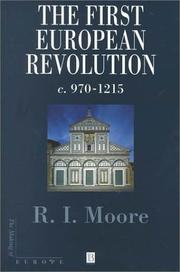
Review of R. I. Moore's "The First European Revolution, c. 970-1215"


[The above video is mostly a reading of the text below, with an occasional aside thrown in for good measure as they strike me as relevant.  I welcome questions, comments, or concerns about the material contained in this video.]


For some reason, it’s been second nature to sometimes think – at least since the time of Burckhardt, it seems - of the Renaissance as single-handedly bringing us out of the so-called Dark Ages, which loomed for almost a millennium after the fall of the Roman Empire. There have been occasional attempts at revising this historiographical conclusion, more notably Charles Homer Haskins’ “The Renaissance of the Twelfth Century,” which offer up details on the incredibly complex changes in science, technology, church life, and agriculture which occurred during this time. In fact, some historians claim that the renaissance to which Haskins refers is actually the third in a series of medieval “re-births,” the first two being the Carolingian and Ottonian, which were both intellectual and artistically important in their own right.

R. I. Moore’s “The First European Revolution” picks up Haskins’ revisionist theme and broads his timeline a bit, stretching it from the end of the tenth century to the beginning of the thirteenth, in order to discuss an even wider range of cultural phenomena. During this time, Europe experienced “profound changes in the economic and political organization of the countryside, amounting to a permanent transformation in the division of labor, social relations, and distribution of power and wealth” (p. 2-3). This is a lot of territory to delve into in just around two hundred pages, and the book does seem to suffer from this excessive ambition. 

At the end of the tenth century, both the potentes (the powerful) and the paupers (not the poor per se, but the powerless) were both responsible for cereal production, which accounted for almost all agriculture. By the end of this time period, however, almost all food was produced by a group of people dependent on others for their survival (serfs), who became a class in themselves of enslaved workers tied to the land by predictable cycles of grain-growing. 

Georges Duby, the French medievalist, outlines the three orders that formed the backbone of medieval society: the oratores (those who pray), bellatores (those who fight), and the laboratores (those who work). At the beginning of Moore’s time period, the first defended the third against the excesses of the swollen warrior classes in the time after Charlemagne, which had exerted their power by the imposition of monogamy, primogeniture, and patrilineage. In time, the Church shifted its support from the laboratores to the aristocratic warrior class, partly because it was promised that land granted to it would never be requisitioned. This is one of the major ways in which we see a Roman Church at the turn of the millennium that is still very loosely organized and weak turn into the powerhouse that it is in the high middle ages. 

There are many other really important cultural and social shifts which are discussed in book which I won’t go into here. Suffice it to say that the book establishes a lot of history that is sometimes left unsaid coming up through the beginning of the middle ages, and it fills in a lot of the blanks concerning how the Church grew to be so powerful over a relatively short period of time. As I mentioned earlier, I wish that Moore would have narrowed his scope a bit and focused on one or two of the major changes instead of all of these. Covering so much ground leaves you with a less even presentation of their impacts, and it can feel like he’s trying to stuff too much information into a short space, which gives it a bit of a textbook feel. 

At least one reviewer referred to Moore’s prose as “lapidary,” a descriptor with which I would have to take issue. I found the writing a bit dry myself, but it’s one of the few affordable books aimed at a non-academic audience which covers this material that I know of, so I appreciate it nonetheless. Moore has written other books on heresy in medieval Europe which look interesting, too.

Review of David Howarth's "1066: The Year of the Conquest"


[The above video is mostly a reading of the text below, with an occasional aside thrown in for good measure as they strike me as relevant.  I welcome questions, comments, or concerns about the material contained in this video.]


The year 1066 is so important, so vital to the course of European history, but somehow we manage to reduce it to “the Battle of Hastings.” That is largely what I was expecting with this short history by David Howarth, a popular historian better known for his takes on more recent history, including World War II and the Battle of Trafalgar. But the most popular battle of the Norman invasion takes up only one chapter of the book, with much of the rest providing a cultural and social history within which you can get a better understanding of the historical arc of the entire year.

Before Howarth jumps into any history, however, he gives sets up a picture of daily life in a village called Horstede, which happens to be where King Harold first learned about William’s invasion across the English Channel. A rudimentary description of the feudal system is given in the first few chapters replete with earls and thanes. We get a discussion of English and Norman politics, including William’s motive to invade in the first place, a topic which requires some psychological second-guessing. Howarth seems to think that Edward had somehow promised William the throne in the last years of his life, and was nonplussed when Harold was immediately selected by the Witenagemot, the Anglo-Saxon advisory council that served the king.

And to confuse political matters even more, there is another Harald – Harald Hardrada, King of Norway (but note the difference in spelling) – who also thought that he had a solid claim to the throne, and was invited to invade English by Harold’s estranged brother Tostig, earl of Northumbria. Harald Hardrada and Tostig both die in what is maybe the penultimate battle of the Norman invasion, the Battle of Stamford Bridge. 

I said “historical arc” above because in the year 1066, Edward the Confessor dies (January 5th), Harold takes the thrown on the very same day, the Norman invasion is won and lost, and William “the Conqueror” takes the thrown again on December 25th. That’s three monarchs in one year – and four if you count the fifteen-year-old Edgar the Aetheling, who held the throne for about two months before being forced to remit it to William. That’s a busy year. 

This isn’t model academic history. There are no footnotes, and there is a lot more conjecture – sometimes couched in the language of verifiable historical record – than I am usually comfortable with. I would approach this as I would any book of popular history: take it with a grain of salt and depending on how interested you are in the subject, consult more scholarly sources. My only complaint about the book is that there is quite a bit of detailed battle strategy (this flank was left exposed, a certain person went Berserk at Stamford Bridge) which I think could have been put to better use in explaining the politics or cultural life; these parts didn’t hold my interest as much. But for all of that, it is engagingly written, and serves as a nice foot in the door for those who want to learn about the major events and the important near-contemporary historians (like William of Malmesbury) through which we know much of what happened that year.