Tuesday, January 21, 2014

Tuesday, January 7, 2014
Review of Mary Midgley's "Wickedness"
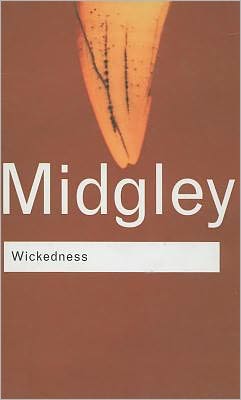
Religious thought, and especially the formalizing aspects of theology, can have the effect of what I call “theologizing the natural.” When you theologize the natural, you take a perfectly earthly, human, natural occurrence or state and you attribute it to a higher power or function. This is what has essentially been done with the problem of human evil, or as Midgley calls it to avoid these overtly theological implications, “wickedness.” Instead of looking at the motivations for human behavior, we look for causes of “sin,” or transgressions against the will of God (note the religiously loaded language). Midgley thinks morality and wickedness are human phenomena. One of the strongest things this book has going for it is that it fights again this theologizing, and looks at human behavior for what it is.
One of points Midgley drives home from the very beginning is that we need to stop seeing wickedness in a Manichean way, as the opposite of goodness. Rather, it needs to be envisioned as a lack of certain capacities: we need “to think of wickedness not primarily as a positive, definite tendency like aggression, whose intrusion into human life needs a special explanation, but rather as negative, as a general kind of failure to live as we are capable of living.” For emphasis, and she does emphasize this point, she wants to see evil not as something that is present, but rather something that is absent: a “general denial and rejection of positive capacities” (p. 16).
She’s just as interested in combating the idea of moral skepticism, that is to say the idea that moral problems as such might not even exist, or if they did exist, that they would not have solutions. Due to the difficulty of moral problem-solving, many solutions (Midgley calls them “overly romanticized solutions”) have been proposed, the most popular of which has been the skepticism that there is no possibility of addressing these problems. But even Nietzsche (commonly and incorrectly regarded as an “immoralist”) knew that such problems existed, and that if there was something even resembling a slight unity in human motive, that they could be adequately answered. Midgley assumes that we can answer these questions because there is something about the nature of human behavior that makes it, for the most part, reliable and predictable. So she assumes a kind of sort determinism (as opposed to the hard kind, which is often assumed to be the position of many natural scientists) and says that these problems can in fact reconcile ourselves to moral problem-solving. More importantly, being able to predict moral behavior does not threaten the possibility of human freedom since we live in a world rife with contingency.
We often try to see wickedness as having one kind of cause, but she wants to argue against this, too. Perhaps one of the more popular causes of human wickedness is aggression. But while aggression is a tendency to attack, it’s not always a violent or destructive one. Aggression no more implies destructiveness than having a foot means wanting to kick someone else. Aggression itself might be the root of some evil, especially if uncontrolled; however, controlled aggression is essential to proper socialization and many other human processes. To imagine a world without aggression (or fear – another emotion commonly reputed to be the source of much evil) – would be to live in a Utopia where we were disconnected from our humanity, if only because our brain chemistry would need to be drastically altered.
In the end, Midgley ends up looking like a certain kind of Aristotelian, at least insofar as she thinks that wickedness is related the incapacity or unwillingness to live in accordance with true human nature. She spends a lot of time arguing against certain strains in contemporary moral thought (reductionism, skepticism, et cetera), but ends up with I’ve always thought was a rather attractive and convincing idea: that thinking through moral problems involves a set of certain capacities including but not limited to empathy, compassion, and understanding which enable real self-understanding and self-realization without which we cease both to be able to know these problems and to offer rational, reasonable, secular solutions to them.
Saturday, December 7, 2013
Review of Saul Bellow's "More Die of Heartbreak"

After I finished “Herzog” last year, I thought it was easily one of the best books I’d read in 2012. This book, published almost a quarter of a century later in 1987, leaves much to be desired. It continues many of the themes that one would readily recognize as prominent in Bellow’s novels – the sordid private lives of intellectuals, especially their romantic relationships, mixed in with a heady dose of the ideas those intellectuals live and work in. The book mostly traces the lives of two of these intellectuals - Kenneth Trachtenberg, a Russian studies professor who has moved from Paris to the Midwest to be at his uncle’s university, and his uncle Benn Crader, the world-famous botanist (or as Bellow cheekily puts it, “plant mystic.”)
Benn, while he’s had a phenomenally successful career, is utterly clueless about his romantic life, and Kenneth mercilessly dissects his private failures throughout the novel, in a way that almost makes you question his supposed reverence for his uncle. He repeatedly brings up – not to Benn in conversation, but to the reading audience - a one-time sexual encounter that Benn had with an older, drunk neighbor to whom he claimed to not be attracted but slept with anyway. She is exasperated when he then seems uninterested in her romantic intentions. Later, he meets a woman named Caroline who is manages to be simultaneously aloof and overbearing. Later still, he meets Matilda who claims to want an older, intelligent man. Benn marries her without Kenneth’s knowledge.
Kenneth, not surprisingly, has romantic problems of his own. While Benn is planning a wedding to Caroline, he is visiting Treckie, with whom he has one child. He notices that since their breakup, she has begun living with man whose sexual aggression has bruised her legs – something that Kenneth always refused to do.
The real pitfall of the novel is where Bellow’s exploration of Matilda’s father’s shady business dealings. He purchased Benn’s mother’s house for pennies on the dollar, only to have him and his friends greatly profit from it. Too much of the novel is spent discussing how Matilda’s father plans to make things right by Benn by seeing that receives a lot of this money so Matilda can get the wealthy husband she deserves. I thought it prevented this rich, deep discussion of the complexities of human relationships from being even better. And as I got further into the book, it seemed like the side story of how Matilda’s father made his living by screwing over Benn’s mother and her children became more central, and because of that I became less interested.
I’m usually not one to run toward facile interpretations which read a novel as a barely veiled version of the author’s own life, but that resisting that temptation is particularly difficult here. One can easily see in Bellow the same capacious intellect and rapacity for the history of ideas that we see in Benn and Kenneth, and consequently perhaps, the same lack of social and sexual sangfroid. Bellow was married five times, and two of those marriages lasted for only about three years each.
Caroline, Treckie, and Matilda could easily be versions of Bellow’s real-life romantic attachments. But even if they were, his trenchant analysis of romantic human needs and desires doesn’t stop with them; he’s just as critical of the detached, cool attitudes of Benn and Kenneth. I don’t think this is one of Bellow’s masterpieces, as I would openly admit of “Herzog” (“Augie March” and “Humboldt’s Gift” seem equally important, though I’ve read neither) but if you have an affinity for Bellow’s writing, this may be of interest.
Thursday, November 7, 2013
Review of E. L. Doctorow's "Homer and Langley"

Homer and Langley have entered the canon of American folklore in a way that few other eccentrics have. Books have been written about them (we all know the kind, best described as “salacious” or “tell-all”), they have been turned into lurid objects of intrigue, almost wholly with little respect for their humanity or the forces that shaped them into the kinds of people they were. Doctorow’s project is different. He is interested in the historical forces that made Homer and Langley, not the sensationalizing journalism that turns them into “hoarders,” a word that thankfully doesn’t even appear in the novel.
After Langley returns from World War I shell shocked, he learns what Homer has known for a while: both of their parents have succumb to the Spanish Flu. Their parents left them a four-story brownstone and an income is never disclosed, but through ingenuity they do well for themselves. They host a series of public dances for the community’s benefit. As time wears on, Langley starts to become increasing paranoid about the household finances, even challenging the utilities companies and the bank who holds the house to come and get what they’re owed from him personally. This is when his collections of books, musical instruments, automobiles, and other material all started to appear.
Throughout the book, both brothers but especially Homer encounter romantic attachments that never blossom. Doctorow draws Langley as a more aloof figure, but I really, truly, deeply felt Homer’s need for love and affection. Maybe like Tiresias his blindness conferred upon him another, greater kind of sight – of innocence, love, and companionship, all of which Langley wanted nothing to do with. All I can really say here is that Homer’s disappointments were heartbreaking for me as a reader.
E. L. Doctorow is as fascinated with American history as Don DeLillo and Thomas Pynchon are with American hysteria. Though this is only my second Doctorow novel (the first was “The City of God,” which I don’t remember much about at all), but it seems that much of his work is crafted in such a way as to have the reader feel that history is actually running past, or even though, you. The effect of this can be both enchanting and disorienting. Doctorow extends their lifetimes by several decades (they both died in 1947) so that we read of them speaking about the moon landing and Jonestown. This is partially what I mean by disorienting. I realize that this is a work of fiction, but this need to extend their lives by more than a generation seemed like an odd, out-of-place decision. I felt that there was plenty of fascinating history to deal with before the date of their real deaths to not have to turn them into centenarians.
On the whole, this was an empathetic portrayal of two people whose historiographies were in dire need of empathy, and I appreciate that. There is something about the overall execution of the novel that I can’t quite put my finger on that leaves me, on the whole, not as moved as I felt I should have been, despite Langley’s experiences in the War and Homer’s failures in love. I’m curious to know what readers of other Doctorow novels think compared to this, or if they can even be compared.
Wednesday, October 9, 2013
Book Haul #13
Birds of America, Mary McCarthy
Exile’s Return, Malcolm Cowley
Lions and Shadows: An Education in the Twenties, Christopher
Isherwood
San Camilo, 1936, Camilo Jose Cela
Conflict & The Web of Group-Affiliations, Georg Simmel
A Preface to Morals, Walter Lippmann
Soul Mountain, Gao Xingjian
A View of the Harbour, Elizabeth Taylor
Palladian Elizabeth Taylor
The Manuscript Found in Saragossa, Jan Potocki
Balzac, Stefan Zweig
The Philosophy of Literary Form, Kenneth Burke
The Complete Lord Peter Wimsey Stories, Dorothy L. Sayers
What’s Bred in the Bone, Robertson Davies
Subscribe to:
Posts (Atom)